Books, Social & Political Issues

BOOK REVIEW: Welcoming the Stranger: Justice, Compassion & Truth in the Immigration Debate

The short story:

1. This is the clearest, most concise, and irenic book on a political issue that I have ever read. (And I don’t say that about many books, feel free to peruse my other reviews).

2. All Christians should read this book. This is an issue about which we cannot remain ignorant and silent. In fact, read it and buy an extra copy for your pastor.

The long(er) story:

I still can’t quite grasp what made a book about immigration so riveting and spiritual, and yet those are the two words I feel most accurately describe this book. While it’s not a page turner a-la-John-Grisham, I found myself chewing on ideas the authors had expressed and longing to know more. Combining the basic Biblical value of care for one another with the need for Christian involvement in immigration support and reform, Matt Soerens and Jenny Hwang lay out a clear, well-documented, and compelling examination of the state of immigration in America.

While keeping the value of the individual at the forefront, they examine the complex dynamics of undocumented workers, the history of immigration in the US, and legal components of our modern day immigration policy. While addressing concerns regarding immigration, they also present the positive effects that immigration has on a society. Finally, they close the book with a call to the church to embrace the ‘stranger among us’. Spiritually, I appreciated most their commitment to integrate justice, compassion, and truth by presenting both individual stories and national responsibilities. Their ultimate perspective seems well summarized through what Intervarsity pastor Bill Nelson says, “Whenever there is opportunity for the church to reach out to people in our communities, we must consider what it will take to further the kingdom. If it means putting down the American flag and raising the kingdom flag, that is what we should do.”

I’ve tried reading other books on immigration, but none of them have been so clear in connecting all the dots between history, policy, and Biblical mandates. Thank you, Matthew & Jenny. You’ve given us all a great gift. I’ll be passing my copy along to as many people as possible!

Books, Families, Children & Marriage

Another new book on Intercultural Marriage

I just saw this on Amazon (published in 2008) and was surprised I haven’t seen it before.  “In love but worlds apart” by Greta Shelling – looks interesting, and the author is certainly well qualified to write the book!  She’s also written a workbook for intercultural couples called ‘Love across Latitudes“.

Books, Families, Children & Marriage

Book Review: Your Intercultural Marriage

When my husband and I started dating 12 years ago, I searched fastidiously for a book on intercultural marriage.  I found two excellent ones:  Intercultural Marriage by Dugan Romano and Mixed Matches by Joel Crohn.  Both were informative, and helpful, but for us, they failed to offer perspective on one important piece – our common bond of faith.  Marla Alupoaicei’s new book Your Intercultural Marriage: a Guide to a Healthy, Happy Relationship seeks to fill this hole.

Your Intercultural Marriage seems best suited for young, Christian cross-cultural couples exploring the waters of intercultural marriage.  It addresses topics such as engagement and weddings, communication skills, food, finances, and children.  It is also full of movie and book recommendations, as well as lists of helpful questions to consider with a potential spouse.  For a couple who has never before considered what dynamics might arise in an intercultural marriage, it is a thorough introduction to the concept.  I will certainly be suggesting it to Christian college couples I know who are considering intercultural marriage. Continue reading “Book Review: Your Intercultural Marriage”

Belief, Books

Book Review: Finding the Flow: A guide for leading small groups and gatherings

flow_cover2So this book really doesn’t have much to do with cross-cultural relationships, but I’ve found it quite helpful on general relationships, particularly those often times awkward ones forged in small groups.  I’m not a huge fan of them, although I do love the general concept of intentionally getting to know people through regular conversation about meaningful topics.  The problem I’ve found is that this rarely happens, at least in the small groups in which I’ve participated.

Finding the Flow addresses this reality and offers some very practical guidance on how to forge meaningful relationships through small groups.  I especially appreciate how the authors encourage a strong knowledge of one’s self in relation to the group, as well as understanding of group dynamics and conflict.  Each chapter has discussion questions and “Do This” exercises sprinkled throughout which are thoughtful, not cheesey.  There are also tons of resources at the end of the book to utilize in small group situations.

While I detest Christian how-to books, I do appreciate clear, concise analysis on concrete yet realistic ways to tackle tough issues.  This book certainly does that with wisdom, clarity, and honesty.  Check out the book’s website for more information and resources.

Books

BOOK: Teach like your hair’s on fire

51fyvsdqg6l_sl500_aa240_I’m currently reading “Teach like your hair’s on fire: the methods and madness inside room 56” by Rafe Esquith.  Rafe teaches in inner city LA and has students who have made significant gains.  He has the students read literary classics and perform Shakespeare.  Rafe has received many awards and recognitions for his work.  Here’s an NPR story about his work.

Books

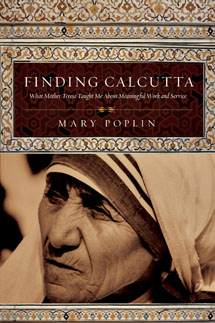
BOOK REVIEW: Finding Calcutta: What Mother Teresa taught me about meaningful work and service

By Mary Poplin

8053Deep down, my absolute favorite thing to do is shop. As I write this, I’m internally scheming how to get the biggest bang for my buck on my next errand. I like things, especially pretty ones, and acquiring them makes me feel good. As I’ve come to recognize this passion of mine, I’ve found it nagging at me a bit. I know people who hate to shop. On top of that, they also hate to accumulate clutter. Their personality enhances their ability to live simply. Not me. I feel better with full bookshelves, cupboards, and drawers. I find malls comforting and thrift stores exhilarating. Quite likely, my pension to store up treasures here on earth runs a bit too deep.

Enter: Mother Teresa, Mary Poplin, Ron Sider, and Shane Claibourne. Since recognizing the grip that my materialism has on me, I’ve embarked on a slow (and slightly reluctant) quest to examine it. I owned the book Rich Christians in an Age of Hunger (by Ron Sider) for about five years before I had the guts to actually read it. Then I joined the crowd reading Irresistible Revolution to find myself completely captured by its fresh and clear vision. This fall, I came across Finding Calcutta: What Mother Teresa taught me about meaningful work and service by Mary Poplin. I’ve long admired Mother Teresa’s work and wisdom; and have also wanted to hear more from Mary Poplin since she spoke on education and poverty at the university where I teach. In spite of my reluctance, my worldview is being reshaped by such books, and my shopping habits are certainly being redefined! Continue reading “BOOK REVIEW: Finding Calcutta: What Mother Teresa taught me about meaningful work and service”

Books

BOOK REVIEW: Zion’s Christian Soliders? The Bible, Israel and the Church

I have frequently shied away from the topic of Israel for a variety of reasons.

1) Its highly controversial among Christians, particularly in the US

2) I’m embarrassed by The Left Behind books

3) I’m not a theologian or eschatologist and the issues seem highly complex

However, as I continue to ponder the implications of the unquestioned support of Israel as a means of justifying war in the Middle East, I grow disturbed at the implications for global Christians. Enter: Zion’s Christian Soldiers by Stephen Sizer. In his book, Sizer addresses the claims of Christian Zionism and its ties to the conservative religious right. He claims,

It is time to speak out because Christian Zionism has become a formidable and dangerous movement. By portraying the modern state of Israel as God’s chosen people on earth, the role of the church has been reduced in the eyes of many to providing moral and biblical justification for Israel’s colonization of Palestine. Those who oppose her are demonized. While not all Christian Zionists endorse the apocalyptic views of Hal Lindsey and Tim LaHaye, the movement as a whole is nevertheless leading the West, and the church with it, into a confrontation with Islam. Using biblical terminology to justify a pre-emptive global war against the ‘axis of evil’ merely reinforces stereotypes, fuels extremism, incites fundamentalism and increases the likelihood of nuclear war.

Continue reading “BOOK REVIEW: Zion’s Christian Soliders? The Bible, Israel and the Church”

Books, Families, Children & Marriage

BOOK REVIEW: Just how married do you want to be? Practicing oneness in marriage

By Jim & Sarah Sumner

[Disclaimer: Given that I’m not very well versed in the egalitarian-complementarian wars, I’m not exactly sure what I think of Jim and Sarah Sumner’s new book Just how married do you want to be? While I suspect I fall more to one side than the other, I don’t have enough cold hard facts to strongly defend my position, so I approached this book with a bit of both skepticism and intrigue.]

What initially intrigued me about the Sumner’s book is that it is written by a female with her Ph.D. and her former male-stripper husband. Talk about an unlikely couple from which to learn about marriage! Regardless of their theological interpretations of gender relationships, surely they have some deep insight into relationship by virtue of being able to stay married! They did not disappoint. With candor and at times painful honesty, they explore how they have transversed their differences to pursue oneness in marriage. While Sarah details how her pride and selfishness prevented pursuing oneness with her husband, Jim discusses how his background his background and temper affected their relationship. They speak in specifics, exploring how their attitudes, issues, and expectations affect one another and how they have learned to respond differently. Continue reading “BOOK REVIEW: Just how married do you want to be? Practicing oneness in marriage”

Books, Social & Political Issues

BOOK REVIEW: The Faith of Barack Obama

After an overt audience preference for John McCain at Saddleback’s faith forum last week, I found myself skeptical that another Christian mainstay (Thomas Nelson) could treat a democrat fairly. However, like moderator Rick Warren, author Stephen Mansfield does a respectable job proving for insight into the spiritual life of the current democratic presidential nominee in The Faith of Barack Obama.

The Faith of Barack Obama appears to be written for a more conservative, evangelical audience. At points, it feels as though Mansfield uses the views of the religious right as the measuring stick for the ‘correct’ faith. When speaking of faith, the perspective with which he compares Obama stems solely from the more conservative Christian viewpoint (as opposed to Muslim, Hindu, etc.) Given the audience, there is no fault in this, but it would be helpful to note this point to better understand the book’s perspective.

In spite of the audience, Mansfield works hard to highlight Obama’s message of unity to the traditionally divided factions of politics and faith. Chapter two opens with an example of then-presidential candidate Sam Brownback and Obama at Saddleback’s World AIDS Day summit. At the summit, Brownback commented that he felt more ‘comfortable’ than he’d felt when they’d shared the stage at the NAACP conference. Given evangelicals’ tendency to lean Republican, Brownback turned to Obama and commented, “Welcome to my house!” In his infamous eloquence, Obama responded, “There is one thing I have to say, Sam. This is my house, too. This is God’s house.” Continue reading “BOOK REVIEW: The Faith of Barack Obama”

Belief, Books, Women

BOOK: 30 Days of Prayer for the Voiceless

Guide to prayer addressing global issues of gender-based injustice.  I just started this this morning, and it is powerful and very difficult to read…  It goes through issues such as abortion, child prositution, domestic violence, eating disorders, female laborers, incest, and pornagraphy.  (Like I said, difficult to read!)

Books, Spiritual Formation

BOOK REVIEW: Sacred Chaos by Tricia McCary Rhodes

(In addition to cross-cultural relationships, another side interest of mine is spiritual formation. I wrote this for some other sites and thought I’d include it here.)

By Tricia McCary Rhodes, 2008. Intervarsity Press.

While I’m an enthusiastic fan of the spiritual formation movement, one of my hang-ups with it is the lack of space in my life to implement practices like silent retreats or prolonged times of contemplation and meditation. It’s not that I don’t long for such times. It’s just that, with two small children, a job, marriage, and household to manage, there is hardly enough concentrated space in my day to use the bathroom alone, let alone carve out extended quality time to spend with God. I might catch a half-hearted 15 to 20 minute quiet time once or twice a week, and then spend the other days feeling guilty that I didn’t stop to read my Bible or say a prayer longer than two or three sentences.

Such is the background on why a book entitled Sacred Chaos: Spiritual Disciplines for the Life You Have caught my eye. In the first few pages, Tricia Rhodes relieved a good portion of my guilt explaining the blur of her own life, and how she would wearily attempt to read her Bible and end up falling asleep. She tells how God orchestrated inevitable chaos in her daily routine in order to take her out of her comfort zone. “He was drawing me into new territory, expanding my borders by exposing my tendency to be far too focused on hours set aside for prayer as the barometer of my relationship with him,” she writes. “What I experienced in ways I’d never imagined was God entering the fray, injecting my busyness wit respites of peace in his presence, punctuating my chaos with the stunning sense that he was drawn near.” Continue reading “BOOK REVIEW: Sacred Chaos by Tricia McCary Rhodes”

Books, Culture & Race

BOOK REVIEW: Reconciliation Blues by Edward Gilbreath

I’ve given up on racial reconciliation quite a few times.The first time was shortly after I discovered it due to my inability to sleep peacefully as I grappled with my newfound understanding of ethnocentrism. The second was when my Asian American husband and I left the segregated and monocultural Midwest for the more integrated and diverse landscape of the East Coast (where racism no longer exists, or so we thought…). The third was when the African American pastor of our mostly white urban church resigned, and it was clear that racial reasons were one of the underlying dynamics that shadowed his pastorate. The fourth and most recent was when we returned to rural Indiana to a landscape of, shall we say, far more (white) milk than (brown) honey. However, it gets a bit tricky to walk out completely on racial reconciliation when you’re married to someone of another race.

Although I am white, I daily face racial issues through the lense of my children and husband. While I easily blend into the crowd, they never do, and I am regularly privileged to experience life through their eyes. In his book Reconciliation Blues: a Black Evangelical’s View of Christianity (Intervarsity Press, 2006), Edward Gilbreath offers a similar gift. With painful honesty, he shares his experience of being an African American evangelical Christian in a white dominated church culture.

Confronting the majority notion that racism in the church is not a pressing issue, Gilbreath observes that “something is still broken.” He offers examples not only from his own life, but also from other African American Christians who struggle to interact with and trust white evangelicals. While he concedes that the church has come a long way from the days of slavery, segregation and lynching, he still questions if we have come far enough, citing the lack of diversity in many Christian organization, and the white majority’s unwillingness to genuninely submit to leaders from other cultures.

Gilbreath begins by describing his experience being the only black person in many evangelical Christian institutions and organizations. He speaks candidly of how he is often expected to speak for his entire race, and to ‘give in’ to the white majority’s unacknowledged ignorance of other cultures.“Many days the weight of it all leaves me exasperated,” he writes. “Sometimes in the silent thumping of my heart, I am haunted by the thought that I will always carry the mantle alone – terrified by the realization that, on a daily basis, if I do not speak up to voice a nonwhite perspective, it will go unheard.”

In addition to sharing about his personal experience, he offers portraits of other publically known black Christians such as Tom Skinner, Martin Luther King, Jr., and (gasp!) Jesse Jackson. Offering a fair treatment of each figure, he shows how their influence has both affected and been received by a white evangelical audience. He even explores how hot-button issues like political associations and cultural over-generalizations effect race relations within the church.

While a powerful read for those already in the throes of the reconciliation movement, I would also highly recommend Reconciliation Blues for those who have not yet entered. The issue of racism – especially in the church – is never an easy one, yet Gilbreath addresses the issue much with gentleness and grace. His vulnerability is a sigh of relief for other nonwhite believers who share his experience of isolation, and a challenge to those of us who too often forget how much we have to learn.