Miscellany

|of egrets and old souls|

DSC_2010-001

Every evening, they come.
One by one,
the egrets arrive at the river
preparing to roost for the night.
They dance from tree to tree,
congregating on the bridge for evening gossip,
and when dark falls,
they find just the right branch,
tuck their noses under a wing
and dot the trees with their fluffing puffs of cotton.
~
She loves to watch the egrets, my grandmother-in-law.
Every night, she perches her tenacious 91-year-old self
on the patio to watch them arrive
on the banks of the Mahaweli.
I sit with her one evening and watch them,
captivated both by the mystery of their patterns
and the joy she still finds in simple things.
We chat about how she watches them every day,
and sometimes even wakes up too-early in the morning
to watch them take off.
Silently I remember that
my own grandfather-a-half-a-world-away
loved these gracious birds too.
 ~
Perhaps
their many years
have given them an appreciation
for grace,
for gentleness,
for slowing down,
for noticing.
 ~
I capture a moment with my lens,
grateful for the wisdom
of the old souls
and the grace
of the egrets.

DSC_1956-001

Books, Culture & Race, Families, Children & Marriage

9 ways to help children develop global awareness

Before our kids were even born, my husband and I knew we wanted to raise our children with an awareness of global reality.  Once they actually arrived, however, we found this easier said than done – especially when living in either isolated or wealthy communities.

When our kids were old enough to process more than Cheerios and Elmo, we wanted to help them develop an understanding of concepts less prominent in American mainstream culture like community, respect for elders, simplicity and generosity that was shaped by something other than the Disney Channel and their peers. Since my husband spent half of his childhood in a developing country at war and the majority of his family still lives there, we were especially keen to help our children growing up amidst privilege understand these realities more deeply. We’ve made attempts at this in a variety of ways, hoping that a few of them will stick:

books header

Beatrice's GoatAn early favorite was reading Beatrice’s Goat by Page McBrier, a true story about a girl in a village whose life changes all because of the gift of a single goat.  There is a developing genre of children’s books telling stories of empowerment instead of pity that includes other titles like One Hen: How One Small Loan Made a Difference and The Good Garden: How One Family Went from Hunger to Having Enough.  These books are all part of Citizen Kid, a book series designed to help children become better global citizens.

Screen Shot 2014-01-01 at 10.24.12 AMProviding a glimpse into a positive view of diversity, Norah Dooley and Peter Thornton have written an absolutely fabulous series about a child who explores the world in her neighborhood by sampling the variations of foods they each enjoy.  Titles include Everybody Cooks Rice, Everybody Bakes Bread, Everybody Brings Noodles and Everybody Serves Soup.  My other all-time favorite storybooks that showcase the world are How to Make an Apple Pie and See the World and Abuela.

A life like mine

Another genre of children’s books we’ve loved are illustrated non-fiction books about actual children around the world.  Our favorites include A life like mine: How children live around the worldChildren just like me: A unique celebration of how children live around the world, If the World were a Village, and The Usborne Book of People of the World.

Screen Shot 2014-01-01 at 2.50.40 PM

Having grown weary of too many depictions of a white Jesus loving on only white children, I’ve also been in search of children’s bibles that reflect the whole world God created.  My favorite is The Jesus Storybook Bible, and World Vision also recently published God’s Love for You Bible Storybook.

videos header

Videos can provide a more tangible reflection of global realities than books, and watching has helped our children get a better sense of how other children live around the world.  Citizen Kid and World Vision both feature child-appropriate videos that explain concepts like the need for clean water, microenterprise and education.  MamaHope also has an excellent series of short videos called “Stop the Pity” which portray those living in poverty with dignity and respect.  Compassion International has a great site (that includes a downloadable study guide!) for kids to learn about poverty called Quest for Compassion.  I’m also a fan of fun videos like Where the Hell is Matt which show the joy and humanity that span the globe.

service header

My son chasing a chicken in Ecuador

While much more challenging when our kids were younger, we’re now in a stage where we can actively participate as a family in service projects.  We’ve helped serve meals for the homeless, visited nursing homes and participated in a service learning trip to Ecuador together.  (While taking toddlers to another continent was certainly a challenge, it has been helpful to embed a personal connection to other realities in their minds.)  I know other families who help at food pantries or tutoring programs.  Serving helps children see beyond themselves, and I’ve been pleasantly surprised by how much my kids genuinely enjoy it.  I’m also a thrift store fan and enjoy talking with my kids about how this kind of shopping serves more than just our own purposes.

food header

We eat at ethnic restaurants as frequently as possible, and have worked hard to help our kids learn about other cuisines.  When we lived in an area where the closest thing to ethnic food was a Chinese/pizza buffet, I buckled down and learned a whole variety of Asian recipes to cook at home.  As a result, we eat Sri Lankan food (check out my curry recipe here) at least twice a month and Asian food about half the time at home.  While they still prefer pizza and chicken nuggets, they don’t scoff at Chinese food anymore and are willing to try a wide variety of foods.  This wasn’t a simple process (there have been a lot of ‘eeewwws’), but our insistence to always try new food is starting to pay off.  Here are some ethnic recipes to try with kids and some tips for introducing your kids to ethnic food.
travel header

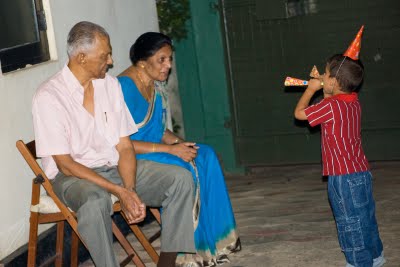
jehan horn
Entertaining aunties and uncles

We’ve also made intentional efforts to help our kids experience a bigger world, whether it be exploring the town down the highway or crossing the globe to see family.  Being an intercultural family, we wanted the world to be something that had always been a part of our children, not something new to which they would be suddenly introduced.  While they don’t remember trips they made as babies, the family we visit remembers, and it has helped our kids develop a comfort with and attachment to another side of their background.  They’ve wrestled with uncles, played cricket with cousins, and kissed aunties.

We also make it a point to visit lots of museums to help the kids can see worlds beyond their own.  My favorite find is the Association of Science and Technology Centers Passport Program which allows free entrance to over 350 museums worldwide.  We recently visited a science center in Kuala Lumpur on a layover for FREE!  For those who travel around the US at all, it’s a quite economical way to visit a lot of different museums while only paying for membership to one.
hospitality headerWhile hosting guests was less possible during the PhD and toddler years, we’ve recently been enjoying welcoming others into our home.  Whether it’s our neighbors who recently moved from China or international students I teach, hosting guests from a variety of places and backgrounds in our home helps our children put a face to the world.  Whenever the news media about a particular country (particularly the Middle East) doesn’t match with the reality of the people they know, our kids notice the discrepancies and often make comments like, “But so-and-so wasn’t like that.”

My introduction to the world began in part because my mom’s family hosted an exchange student from Thailand when she was in high school. We hosted another student from Finland when I was a teenager, and building a sisterhood across cultures proved to be one of the most cherished and foundational experiences of my life.

generosity headerWe openly talk about giving with our kids, and two of the primary means we give are World Vision and Kiva.  Both fund the empowerment of people living in poverty.  I’ll often sit down with the kids and let them pick the microloans or projects we support.  The World Vision site is great because it often includes videos that we can watch with the kids to help them understand just what it means to lack clean water or education.  Watching these videos and then donating money to the projects have opened some great conversations.

imagination headerBecause children naturally love to play and imagine, stories of other worlds  like Narnia and Harry Potter have been helpful allegories in our house.  Such stories help children begin to understand how other lands may have differing customs and realities than their own.  The power dynamics between good and evil also help us explain the comple dynamics of world politics in more kid friendly ways.

simplicity headerI am not naturally a simple person.  I love shoes, ice cream, and soft beds.  I like to shop and window browse and decorate.  However, being married to a spouse from the developing world, I’ve had many occasions to grapple with what is necessity and what is luxury.  Hence, I’ve spent a lot of time over the years sorting out my materialism, and looking for ways to simplify my life in light of how much of the world lives.

It has in now way been a perfect journey (I still have a weak spot for shoes), but as it turns out, pretty much most things are luxury past food and shelter.  As a result, we do the best we can to live within our means – no credit card debt, used furniture (my favorite chair has a big hole in the arm), simple schedules and intentional budgets.  While we live in a small house and drive old cars, we often discuss with our kids how wealthy we are because we have these things at all, regardless of whether or not they are new.  In turn, our imperfect efforts toward simplicity remind us to be grateful for the abundance we do possess, and enable us to give generously as well.

What about you?  What are ways you help your children learn about the world?

Related Posts

Further Reading

Miscellany

Versatile Blogger Award

versatile-bloggerI was grateful to receive a Versatile Blogger Award nomination from Searching for Substance and humbled to read her description of my blog:

Between Worlds – a blog that cuts to the core of the things that matter, she writes often about topics that are too hard to talk about. like racism. or separation in the church. or marriage. or work. or immigration and resettlement. Difficult stuff, but expressed so eloquently and thoughtfully.

Thanks, Soapie. These words are the best part of the honor.

Part of the nomination is the write seven random things about me.  While I love reading such lists, I find them terribly difficult to write.  Here goes:

  1. I once sang the Theme from Titanic (or the ‘Jack and Rose’ song as they called it) to a group of rural Thai school children.  The sad part is that I don’t sing very well and didn’t even know the words to the song, but it was the one thing they wanted to know about the US.
  2. The hardest-superficial-part of traveling for me is the lack of uber-comfortable furniture and cold drinks.  Go ahead an slap an American flag on my forehead :).
  3. I actually prefer squat toilets to sit-down ones.  Waaay more sanitary!
  4. My guilty pleasure is watching cute animal videos on YouTube with my kids.  I have a hard time laughing sometimes and I love the reason to giggle. My absolute favorite are the BBC’s Walk on the Wild Side clips.
  5. I’m an ocean girl.  Mountains are pretty and all, but I could sit beside the sea forever.
  6. I hate to clean.  In fact, if you came to my house, you might actually find me comfortably writing away on the couch while my husband scrubs the floor.
  7. Clearly, I married really well.

And now for my nominations:

Shalom is for the City.  Osheta writes with boldness and grace, honesty and gentleness about everything from   race to faith to church-planting to peace-making to mothering.  She will stun you with her wisdom and relax you with her humor.

The Beautiful Due.  John Blase’s poignant and beautiful poetry about the spiritual realities in every day life.

A life with Subtitles.  Sarah writes navigating the challenging and fun realities of bicultural and bilingual families.

Communicating Across Boundaries.  Marilyn’s writes about everything from third culture kids to growing up in Pakistan to Orthodoxy.  Her writing is both beautiful and practical, and she hosts a wide variety of guest authors speaking to cross-cultural topics.

Grace Biskie.  Grace is a biracial woman who writes with hopeful honesty about race, recovery from abuse, mental illness, and justice.

The-best-ones

Top-posts-of-2013

Here’s a recap of the most popular posts on Between Worlds this year…

10.  Intercultural marriage: A model of reconciliation

9.  What my grandpa knew

8.  When even Jesus is white

7.  What I do wrong with race: Confessions from a white woman

6.  That time when white people talked about being white

5.  Iceberg Concept of Culture

4.  Dear white man:

3.  10 reasons I’m reading Harry Potter to my children

2.  Bridge building

1.  When white people don’t know they’re being white

swirl

While these posts weren’t as widely read, they reflect some of my personal favorite moments of 2014:

Wishing you all the meaningful and joyous New Year,

Jody

The-best-ones

The-best-ones-in-December

The-ones-about-Christmas

Dear kids: What you need to know about Duck Dynasty, Justine Sacco, and Christmas by Ann Voskamp. “Whoever said sticks and stones may break your bones but words will never hurt you? Was dead wrong. Ask a bearded guy from Louisiana or a tweeting PR exec en route to Africa to comment on that. Don’t ever forget it, kids: There is nothing more explosive than words.”

Me and the oldborn king by John Blase.  A beautiful poem about the steady pursuit of God.

Rethinking the nativity by Rachel Pieh Jones.  “We want to make the birth of Jesus as hard as possible, as cold and lonely and desperate and painful as possible. Why? Is it because we can’t grasp the infinite coldness, loneliness, desperation, and pain of what the incarnation truly meant? We wrap it up in dirty clothes and stinking animals, in physical loneliness and fear. Is our feeble attempt at re-imagining the Christmas story our way of trying to understand, to put images and emotions to something so powerfully and deeply beyond our comprehension? To bring the miracle of God-made-flesh into our realm of understanding?”

Christmas is cross-cultural by Christena Cleveland. “Our Christmas celebrations often turn us culturally-inward. We focus on our biological/cultural families, our traditions, and exchanging gifts with those inside our social circles. These things are great! But if we truly want to commemorate the Incarnation, we must turn culturally-outward. We must follow our great High Mentor – and leave our cultural enclaves in order to inhabit each other’s stories this Christmas.”

The-ones-about-mustering-up-courage

Oh, Honey! Come Here, I think your privilege is showing by Osheta Moore.  “Since I wrote last on racism, privilege, and diversity, I’ve had several white bloggers, most of them happen to live or come from the South say to me, “I really want to talk about this but I don’t think I have the right to, I mean…I’m white”. To which I say, because you’re white, you need to talk about it.”

Father’s heartbreaking journey after losing his wife post childbirth.  “”I wanted to take this thing that happened to me, this really, really awful moment in my life, and turn it into something beautiful so that [Maddy] could look back and see the love story of my time with her mom. And my love story with her,” Matt says. “There’s two different love stories there.”

Guy brings his white girlfriend to a barber shop and gets hated on by eBaum’s World.  Watch this remarkable video on how people respond to racist statements about an interracial couple.

The-one-that-made-me-grin

America’s longest-married couple to celebrate 81st anniversary.  Their secret?  “We have watched the world change together,” said John Betar. “The key is to always agree with your wife.”

The-ones-about-Nelson-Mandela

Dear Mandela, the only way I know how to walk now is long and free by Idelette McVicker.  “I can be, because Mandela has been. Strong, proud, wise, graciously forgiving, tenacious for freedom.”

On Nelson Mandela, Jesus, and Our Sanitized Stories by Hannah Heinzekehr.  “Nelson Mandela was a great man and a great leader. This is true. But as I watched all the coverage surrounding his life and death, something struck me. I was struck by how quickly we humans can tend to sanctify and sanitize a person and their story. I was not alone in this observation. Shortly after his death, The Daily Beast ran an article entitled, “Don’t Sanitize Nelson Mandela: He’s Honored Now, But Was Hated Then.”

10 Human Rights Activists who made 2013 a better year for humanity.  “Our beloved Nelson Mandela once said that, “A good head and good heart are always a formidable combination.” As we celebrate the 20th anniversary of Human Rights Day today, let’s celebrate 10 individuals around the world who are living by Mandela’s words and helped make 2013 a better year for humanity.”

The-ones-about-Jesus-being-white

Fox news host Megyn Kelly tells Kids: Jesus and Santa are both white guys.  No wonder my daughter thought even Jesus was white…too much Fox news for her? 😉

Call Jesus white? Expect a big fight by Edward J. Blum.  “All the chatter about Jesus being white (or not) shows how much America has changed. There used to be “whites’ only” restaurants and schoolrooms. Now, even Jesus cannot be called white without repercussions.”

Insisting Jesus was white is bad history and bad theology by Jonathan Merritt.  “If the Bible is silent on the matter of Jesus’ skin color, does it really matter that Megyn Kelly says Jesus is white? Yes, actually.”

Jon Stewart’s reaction = priceless.

Popular-ones-on-BW

When even Jesus is white.  “Those blasted colonialist publishers who had to go and make Jesus look just like them – they were fully responsible for my child feeling on the outs.”

Dealing with anger in race relations. “I have often heard people of color express a similar anger toward the inequitable system that keeps racism alive and kicking, but living with my non-white family in a majority white setting made my experience with anger and race take a new turn. The longer we lived there, the harder it was for me to assume good-intentions when the bad-actions were so obvious. Over time, I grew angry with white-people myself.”

Iceberg concept of culture.  “In intercultural relationships, simply talking about some of the rules guiding the unspoken and unconscious rules of culture brings a new level of awareness in understanding how to relate to one another.”

Social & Political Issues

The evils of blogging?

When people ask me what I do, I never say I write.  It’s a little secret I’ve kept mostly tucked away from those who know me because saying I’m a teacher draws fewer suspicious looks, and it’s easier to stick to the safe conversations.  In fact, if one of my posts hadn’t gone viral a few months ago, I’d still be quite contentedly writing in the shadows without anyone I know but my husband knowing about my words here.  (I even get all-worked-up when he tells people we know that I have a blog.)

It took a long time for me to come to grips with being a writer even though I have been writing nearly my entire life, won writing awards, served as a school newspaper and literary magazine editor and been published in a variety of publications. Somewhere in my adjustment to the adult world, I determined that ‘real adults’ are private, composed, and don’t put their thoughts out there for the world to critique.  As a result, I’ve got all the arguments against writing publicly on a blog down cold:

  • It’s egotistical to put your own thoughts out there.  Who really wants to read all about someone else’s life?
  • Why spend all that time in the virtual world when there are real people out there?
  • Self-promotion and ambition are obnoxious (especially for women).  Why not just live quietly and well without the pursuit of a ‘platform‘?
  • All anyone does is fling words at each other.  Everyone has an opinion and no one really listens to anyone else.

All these reasons make perfect sense to me, and I even agree with them on occasion.  One of my favorite authors, Jan Johnson, has written about how she doesn’t self-promote much as a spiritual discipline.  I totally get and even respect her thinking.  The expectations of self-promotion and slick-marketing tactics for writers in the current publishing market are downright ugly at times.  As a result, you rarely find her books in bookstores or libraries – not many people have heard of her.  It’s a sad reality of voice and power that the squeaky (or pretty or best-packaged or most-connected) wheel really does get the grease, one that tempts my typing fingers toward complete stillness.

However, when I found myself living lonely in the middle of a cornfield in an interracial/intercultural family, I desperately needed to find others in similar situations and started a blog just to remember that I wasn’t really alone.  Over the years, I’ve found a variety of others just like me, and their simple presence in the world gave me courage to live as I was created, even when it was so very different from those around me.

I first found Idelette in Vancouver in the early stages of SheLoves.  Then I found a like-minded TCK in Australia, Kathy in Chicago, and the ever-brilliant Rachel Held Evans in Tennesee.  I also stumbled upon a whole host of intercultural blogs through the DesiLink Blogs and Multicultural Bloggers networks.  Most recently, I’ve been learning from Marilyn in Boston and Christena in Minneapolis and Rachel in Djbouti.  Connecting to this virtual world was like someone entered a very dark room and turned on the light.

So in spite of my hesitancies, I’ve written here sporadically for over six years now, with a short shut down to contemplate if it was worth continuing at all.  (In the midst of processing some intense anger, I wasn’t sure it would be healthy to have access to a public outlet for my voice.) When a friend asked me to write for a new blog discussing women’s issues, a part of me awoke. Reluctantly, I reopened Between Worlds.  While the above critiques still hold regarding the blogging world, since I’ve been writing again, I’ve also discovered some positive surprises about this brave new digital arena.

Similar to Eric Liddell from Chariots of Fire, practicing a craft that I was made for feels purposeful and right.  In short, I feel God’s pleasure when I write.  Liddell’s deeper explanation of his own purpose challenges me when I consider what to do with the skills God has given me:

You came to see a race today. To see someone win. It happened to be me. But I want you to do more than just watch a race. I want you to take part in it. I want to compare faith to running in a race. It’s hard. It requires concentration of will, energy of soul. You experience elation when the winner breaks the tape – especially if you’ve got a bet on it. But how long does that last? You go home. Maybe you’re dinner’s burnt. Maybe you haven’t got a job.

So who am I to say, “Believe, have faith,” in the face of life’s realities? I would like to give you something more permanent, but I can only point the way. I have no formula for winning the race. Everyone runs in her own way, or his own way. And where does the power come from, to see the race to its end? From within. Jesus said, “Behold, the Kingdom of God is within you. If with all your hearts, you truly seek me, you shall ever surely find me.” If you commit yourself to the love of Christ, then that is how you run a straight race.

His words force me to consider if a part of my ‘race’ might be writing – not for fame or riches or reputation, but for faithfulness.  For others, the race may be caring for a disabled child or researching or single-parenting or song-writing or dancing or coaching.  What more can any of us do ‘in the face of life’s realities’ except run the race we were given as straight as we can?

Brené Brown rocked all of our worlds with her research on vulnerability and shame.  A data driven researcher, she faced a personal breakdown when her data showed that “whole-hearted people” live well because of their ability to be vulnerable.  To be honest, there are more than a few moments when I sit behind the screen with shaking fingers, wondering if I should really hit ‘publish’ (especially the provocative viral post), but as I both share and listen to others, I learn time and again that vulnerability has a healing power.

In addition to vulnerability, I have a firm conviction that gut-level honesty must have a place in the church.  Somewhere along the way, we’ve adjusted the message that Jesus came to heal broken people to expecting perfection to walk through the church doors.  While some may criticize that it’s not attractive to air our dirty laundry, I have found it far more damaging to pretend I’m something that I’m not.  Perhaps my thoughts here aren’t perfect or spiritual or positive enough.  Perhaps there are times when I complain or whine or get too cynical.  If I do, please know that it’s somewhat intentional for the reality is that I am far more dirty-handkerchief than pristine-snowfall.  If mothering’s taught me anything, it’s that nothing comes clean if we simply pretend it’s not dirty.

I must admit that while I’ve never read Thomas Merton’s book No Man is an Island, the title alone haunts me.  I can be quite an independent soul, so that may explain why this phrase is jars me.  Writing in the public sphere forces me to walk boldly in the truth that I am not an island, that I need others to be part of my story.

Finally, one of the most fascinating outcomes of the always-connected technological revolution is the ability to form a collective voice without anyone’s express permission.  While this isn’t always a positive thing, there are times when it’s astoundingly moving.  The collective voice matters because it gives public voice to those who have traditionally not had access to one.  When large groups begin to voice dissent on an issue those in power have conveniently ignored, social norms change.  A few examples include the Arab Spring, the growing protest of patriarchal leadership models in the church, the reframing of stereotypes regarding sexuality, and the growing attention to global injustices like human trafficking and AIDs.

As we consider the impact of the ever-expanding world of social media and digital connectedness, we can either decry the shallowness, running the other way with the luddites or we can engage and push it to dig deeper.  Perhaps there’s some value in both responses to the megabytes, but for those of us wading in their fray, let’s lead the way with a few extra shovels.

Further Reading

Belief

The wild and sweet conflict of Advent

Christmas songs are supposed to be happy. Jingle bells ringing, happy people singing, red noses shining, and bringing good tidings – that’s the epitome of the Christmas spirit – right?

In many moments, I share this joyful sentiment. I love the wonder and anticipation of the season and how Advent invites us to pause and reflect. But sometimes, simple acts like reading news of war or chatting honestly with a broken friend leave me relieved that sentiments like Henry Longfellow’s make it into the season too:

And in despair, I bowed my head:

“There is no peace on earth,” I said,

“For hate is strong and mocks the song,

of peace on earth, good will to men.”

Written near the end of the civil war after the tragic death of his wife and serious injury of his son, I can only imagine the grief that shook Longfellow’s heart. “How inexpressibly sad are all holidays,” he wrote the Christmas after his wife’s death. “I can make no record of these days. Better leave them wrapped in silence. Perhaps someday God will give me peace.” Three years later, he penned the words to the beloved carol, I heard the bells on Christmas Day.

Silent.

Expectant.

We might all be better for it if we walked through advent like this. Certainly all of our hearts carry unmet longing and unresolved burdens, even through a seemingly joy-filled season. I fluctuate somewhere being parading my longings and burdens boldly before God and scrambling to cover them up so no one else can see my lack…

Perhaps Longfellow felt the same way that Christmas morning when he heard the bells ringing the old and familiar carols.

…and wild and sweet, the words repeat of peace on earth, good will to men.

For even if the song of peace is sweet, it can still be wild, elusive, unpredictable and uncontrollable. And even if good will to men runs wild, it can still hold an underlying sweetness, immeasurable pain interwoven with threads of hope and goodness. The sweetness of the season rings through warm moments, celebratory spirits, joy-filled children. But the wildness is just as present, highlighting the very present conflict of unresolved tensions, global injustices, misplaced priorities, feelings of grief, and pressures of holiday obligations.

These incongruous realities of advent prompt us to quiet our spirits and listen rather than to numb them with busyness, to seek hope through meaningful actions rather than chase happiness through meaningless objects. They beckon us to live quietly yet expectantly in a world of crashing noise. In the quietness, we can pray simple words like this:

May we return to the breath and the silence.

To the breath that gives us life,

To the silence where we hear God’s whispers.

May we weep for the brokenness of our souls,

And cry out against our distractedness.

May we return to the eternal God,

Whose love fills every fibre of our being.

(Christine Sine)

.

Come, Lord Jesus. We eagerly await your arrival, wild and sweet.

swirl

This advent reflection was originally posted on my friend Amy’s blog, Making all things new.

Restoration & Reconciliation, Spiritual Formation

Remembering the human in the age of digital mud-slinging

remember the human

“Words are, in my not so humble opinion, our most inexhaustible source of magic, capable of both inflicting injury and remedying it.” – Albus Dumbledore

I knew a man once who grew up watching his alcoholic father beat the life out of his mother.  A friend whispered to me that, as a little boy, he would run to her house in tears to hide, afraid of his own home.  Over the years, the violence hardened him.  By the time I knew him, he was no different than his father, filled only with rage and alcohol. Sadly, I watched his children repeat his boyhood story of hiding their tears in neighbors’ homes.

Before I learned about the pain of his childhood, it was easy to label this man idiot and asshole and abuser.  While his rage scared me, I also knew different.  Though he appeared a violent and ruthless man, I could not help but also see a teary, scared little boy hiding from his father in a neighbor’s house.  This one fact changed the way I thought about, prayed for, and responded to him.

Sometimes, I muse that there are corners of the North American church that reflect the life of an alcoholic like this man.  We come from so many places and perspectives and experiences.  We have different needs and hurts and hopes and dreams that shape how we understand The Story God left for us.  For some, the Bible has proved no better than an abusive father, having been used to beat us down and send us hiding in neighbor’s houses, tears streaming down our hearts.  For others, it has been the authority of life, a testament to be revered,  followed-to-a-T and never challenged.  Still for others, it has been a life-changing, restorative and hope-filled new way.

As I participate in the conversation emerging in our digitized world, I’ve observed that social media has become a great venue for our alcoholic traits to rear their ugly heads.  From the safety of our computer screens, we rant and rage, accuse and deny, promise and fail, stereotype and namecall.

Paul’s words from 1 Corinthians 1 haunt me every time I smugly disdain or praise the public voices who I find either ridiculous or brilliant.  We might as well just substitute new names for our Big Fight: “One of you says, “I follow John Piper”; another, “I follow Rob Bell”; another, “I follow Joyce Meyer”; still another, “I follow Jesus.”

His words haunt me primarily because I do this very thing. Paul is talking about me.

[Gulp.]

I recover quickly from my conviction because, let’s face it, folks: some people are wrong.

There are racist people out there, people who are prejudiced and mean-spirited and divisive, all in the name of Jesus.  There are people who preach that following Jesus will make you rich.  There are people who put on a good show just for the money and the fame, using Jesus like a trick-or-treat costume to reach the ranks of the kid-with-the-most-candy.  There are people who preach a beautiful grace from the pulpit but can’t manage to apply an ounce of it to one single person in their life.

I judge them, flinging my mental rants at them because I don’t want them messing up the life-giving message of the gospel that Jesus came to save us at our worst.

The very-sticky-problem is that the very people I deem ‘wrong’ may well think the same of me.  So we polarize, mudsling, stake our ground, call for schisms, and tweet and post our disagreements with furor.  It is perhaps one of the most complexly sad sights of the American protestant church today.

swirl

One of the most potent lessons that living between worlds has taught me is that people have many sides.  As I’ve lived among both rural and urban poor,  wealthy coastal elites, perseverant immigrants, powerful politicians, awe-inspiring performers, stodgy academics, consumeristic metropolitans, shallow surbanites and simple minded small-town folk, I’ve rarely seen any of them live up completely to the stereotype their namecallers hold them to.  The media shouts that red-states-hate-blue states and vice versa, but the story that we’re slower to remember is that everyone – regardless of ideology – loves, wants to love or be loved.

In the age of opinions becoming digital sound bytes, it has become far too easy to fling our anger at each other and forget that we are humans, not screens.  “The person-who-disagrees-with-me deserves my wrath because he is WRONG,” we chant.

I get it.  I’ve been on the receiving end of threatening phone calls, of bigoted teenagers in pick-up-trucks, of name-calling and assumption making.  It wounds.  It infuriates. It keeps me awake at night.  It sends me running to my neighbor’s house in tears. But as much as my gut reacts otherwise, it is not the way of Jesus, even when “they” are wrong.  

Father, forgive them, he said as they took his very life.  Seventy times seven, he’d told his followers.

Turn the other cheek.

If someone wants your shirt, give him your coat as well.

I nearly walked away from Jesus once, but one of the primary things that drew me back was learning more about the ‘other way’ of which Jesus speaks.

Love your enemies.  Pray for those who persecute you.  

Don’t do your righteous acts for others to see.

If possible, live peaceably with all men.  

swirl

Whenever I hear people from one region of the country disparage the ‘crazies’ in another region, I find myself getting strangely defensive regarding traits that drive me equally crazy, You don’t understand, I want to explain. They’re more than just red and blue, conservative and liberal.  They’re humans, just like you. In the words of my witty Grandpa John, “Everyone puts their pants on one leg at a time.”

We are one in the spirit, we like to sing but struggle to live.  I recently heard Michelle Bloom, a singer-songwriter, point out how we often overlook the words at the end of the second verse, We will work with each other, we will work side by side. And we’ll guard each man’s dignity and save each man’s pride.

As we navigate this topsy turvy path of our new digital world, let’s practice a new way of talking to and about each other as we stumble along the path toward unity.  When we remember the human behind the screen, we echo the very words of Jesus as we seek to protect every man’s dignity.  While this does not mean we will all come to the same conclusions, it does mean that we commit to walk alongside one another in our humanity with respect for the God-given dignity of all our fellow sojourners, not just the ones with whom we agree.

Further Reading

Spiritual Formation, Travel

Living in light of global reality

The heaviness of the tropical air settled on us as we waited for our baggage, two pieces of which had been lost. It was an instant reminder that life marches to a different beat in the developing world than in our Organized States of America. After a seeming eternity, we pushed our overloaded baggage cart through customs to finally embrace my husband’s parents who were convinced we’d missed the plane. As we left the airport, our arrival into another world descended on us quickly.

Driving in Sri Lanka looked more like a chicken fight gone bad than cars following rules of the road (what are those, anyway?). Piles of trash covered random street corners, their putrid odor overwhelming passersby. I breathed it all in deeply – finally, a vacation!

For me, the word vacation usually conjures up images of resorts, beaches, and relaxation rather than of bad driving, inconvenience and trash heaps. Yet as we’ve spent our days in Sri Lanka over the years, I’ve experienced a vacation of a different sort, for I did not occupy myself with the same kinds of expectations I carry with me in the U.S.

In the US, when I sit in an uncomfortable chair, I curse under my breath at the negligence of whoever must be at fault. In Sri Lanka, I was grateful to get a chair under the fan, comfortable or not. Here, I concern myself greatly with the tastiest brand of apple sauce or ice cream. In Sri Lanka, I’ve recognized that eating these foods at all is a luxury. Here, I rush to the hardware store to buy ant poison upon the discovery of a few ants roaming my living room floor. In Sri Lanka, the ants roam so freely and abundantly that on occasion, I’ve stopped on occasion to study their resourcefulness, order and determination.

In America, vacations nourish my self, surrounding me with opportunities to be served and relax. In Sri Lanka, the vacation was from myself, from my daily list of expected rights and materialistic consumption.

In Sri Lanka, I do not have the luxury of ignoring the reality of the harshness in our world, for it has all been in my face at once: poverty, injustice, beggars shadowed by a history of war, tales of child soldiers, land mines, suicide bombers. I do not step outside the gate without a breath of prayer for the safety of myself and my family, or pass a beggar-in-front-of-a-mansion without seething at the inequitable distribution of wealth around the world. I do not read the paper without shaking my head at the greed, selfishness of the-hands-that-hold-the-power.  I do not walk into the homes of my family with out breathing deep their resilience, faithfulness and fortitude amidst all of these realities.

Even in light of such immediate chaos, I still find myself easily consumed by my own humanness. Daily life settles in, and a battle between the global and the personal ensues.

My children wake up from jet leg four times in one night = despair … but at least they have a bed to sleep in.

The heat is so exhausting I can barely keep my eyes open = whiny attitude necessitating an afternoon nap … but at least I have a place and time to take a nap and a fan to sleep under.

A taxi driver cheats me because I am a foreigner = indignance! … but at least I have enough money to even be a foreigner, let alone get cheated.

My in-laws don’t get to see my sweet kids actually be sweet due to their 10 hour jet lag = pouting … but at least they get to see them at all.

Clothes are sooo cheap here.  I want to buy as much as I can! = greed … but the break from the obsession of American materialism is so refreshing.

swirl

“The mind wants the world to return its love, or its awareness; the mind wants to know all the world, and all eternity, and God,” writes Annie Dillard in Teaching a Stone to Talk. “The mind’s sidekick, however, will settle for two eggs overeasy.”

When I taught at a wealthy Christian university, I would dialog with students about what my husband calls “living in light of global reality”. We would discuss such complexities as the inequitable distribution of wealth, the lack of proper health care, the travesties of ethnic conflict and corrupt governments and what that meant for our personal and professional lives.  Occasionally, I’d run into an unusually naive student (usually a freshman) shocked at the prospect of poverty, but overall, the students were more trying to grasp a reality they had never known themselves.  Their background of privilege and sheltered lives made it difficult to understand another world, and even more challenging to determine how to make daily decisions in light of this reality.

It meant a lot of paradox for all of us.  Great compassion for children with AIDS or sex-slaves or racial inequities vs. buying new shoes to keep up with the trends.  Seeking a deeper understanding of the world vs. obsessively following the coolest music scene.

As I grow older, the questions only magnify.  Public schools or private? Suburbs or city? Safe or risky? Internally, I see that there are things far more important than my trendy new shoes or funky hair-cut. However, I continually grapple with the concept that ‘just because I can, doesn’t mean I should’ acquire, accumulate, and keep-up-with-the-Jones. As much as my mind throws its weight around by trying to be aware, my will acts far more often as its sidekick, settling for eggs over easy and a cute pair of shoes.

After years of ‘vacations’ in a war-torn tropical paradise, I’m slowly understanding this word paradox. It surfaces not only in the breath-taking beauty and heart-wrenching injustices of Sri Lanka, but also in my truth-seeking mind and self-seeking will. Living in the developed world, I face a constant tension to live in light of global reality because the pressure to keep up with the neighbors usually outshouts the hungry stomachs and unseen injustices in my direct line of sight.  (Even my dear mother-in-law comments when she visits how tempting it would be to buy things when they’re packaged so nicely).   In light of this tension, I count it a great gift of intercultural marriage to have reason for this reality to be part of my own family.

For Western believers, living in light of global reality means we need to spend far more time facing our role in better responding to these paradoxes, not shying away because we don’t understand. We begin this process by seeking to live humbly with each other, by listening for voices big and small, and by examining where our treasures truly lie.  A daunting task to be sure, but one that our Father clearly calls us to.  “The earth is the Lord’s, and everything in it,” the Story tells us.  May we care for more than just our little corner well.

Related Posts

Families, Children & Marriage

Dancing between career and family

Join me at The Junia Project today where I reflect on the dance of submitting to one another in marriage.  I recently left a career I loved for my husband to advance in his, but the reasons behind our choice are different than they may appear.  Here’s a little glimpse…

One of the guiding principles my husband and I have operated on throughout our marriage is that we make our decisions for the good of the whole.  Given my type-A personality, I used to function as though our marriage was “The Me Show”.  As my husband and I matured in our relationship, however, I began to see that it wasn’t true equality if I ran the show – it was just reverse patriarchy.  The equality in our relationship was beneficial only so much as it sacrificially considered the other, and understanding this equality was what taught me how to submit not as a subordinate, but as an equal.  This dance of giving way to one another was about to take a new turn, and we both knew we’d need to learn some new steps.

Click here to read the rest on The Junia Project.

Culture & Race, Restoration & Reconciliation

Dealing with anger in race relations

As I’ve participated both publicly and privately in the race dialogue over the years, one of the most difficult aspects I’ve navigated is the role of anger in race relations.  It’s not hard to see – the comments section of race-related articles demonstrate well the heated presence of anger in race relations.  For those seeking to walk the path toward deeper cultural understanding, understanding the roots of racial anger is an area that we can’t afford to dismiss.  As a white person, I’ve been surprised to encounter my own battles with anger and race, and I share from that experience here.

swirl

My first teaching job was in an historic black school in a Midwestern city, and it was a crash course in understanding dynamics of urban settings, race, and poverty.  Being brand new to the professional world, it is highly probable that my youthfulness translated into a white-savioresque attitude à la Dangerous Minds, even though I didn’t consciously enter with this perspective.  In spite of my intentions, I encountered two quite contrasting responses to my naïveté.

The first was from an African-American teacher next door who railed angrily into me one day for something I’d done that irked her.  I don’t remember a word of what she actually said to me, but I clearly remember returning to my classroom in tears, feeling crushed by her anger and assumptions regarding my white ignorance.  I’d tried to seek her insight out on previous (failed) attempts, and now she’d shut me down for good.  From that point on, our relationship was one of icy glares and cold shoulders.

The other response was from another African-American teacher who kindly took me under her wing.  She showered me with hugs as she gently taught me the basics of African-American history and urban culture.  She took kids home with her when they needed a mama and brought them breakfast at school when they were hungry.  All the kids knew that you went to her classroom first if you needed some extra love and I followed their lead frequently.

While Loving Teacher’s response felt better than Angry Teacher’s harshness toward me, both reactions taught me vital lessons in the world of race relations.  Nearly fifteen years later, I cringe at my youthful self with a grateful nod to the lesson Angry Teacher taught me.  After I got past the initial sting of the Angry Teacher’s reaction (which, I might sheepishly add, took years), I began to contemplate why she may have responded the way she did.   She’d lived down the street from these kids and their parents and their pastors for longer than I’d been alive, and she knew a reality that I didn’t.

As I’ve reflected on it over the years, I’d guess that her anger spewed on me that day stemmed more from the continued systemic racial injustice that she navigated on a daily basis rather than from my specific actions.  My young white skin and curiosity simply represented the cycle of systemic injustice that had reeked havoc on her home, and it (understandably) made her angry with me.  For all the good I hoped to do in that context, it forced me to acknowledge that she was the one with the lasting influence and that I was simply an observer passing through.

swirl

I have often heard people of color express a similar anger toward the inequitable system that keeps racism alive and kicking, but living with my non-white family in a majority white setting made my experience with anger and race take a new turn.  The longer we lived there, the harder it was for me to assume good-intentions when the bad-actions were so obvious.  Over time, I grew angry with white-people myself.

I was angry that ‘my people’ wouldn’t embrace my family like they did people who fit into their pretty-little-cornfield-box.  I was angry they didn’t care enough about the world-outside to understand people from it.  I was angry they clammed up and smiled when they didn’t understand something rather than just admit it outright.  I was angry they dismissed others’ perspectives with Christian platitudes just to ‘keep the peace’.

Over the years, I’ve asked people I hold in great esteem how they’ve managed to keep going through the anger that inevitably comes with interracial relationships.  I’ve had more than one day year when I’ve shut down on the whole thing.  The last bout nearly did me in completely.  But then, the air came as we surfaced somewhere near Los Angeles gasping for breath.  We sat quietly vibrating in the shadow of the mountains and on the edge of the sea for over a year.  

Little by little, I leaned on the wisdom from people ahead of me on this path to sort out the pieces of my anger over our experience in a land that did not understand its impact on those who were different within its borders.  Since everyone processes these things differently, I’ll recap a few things I’ve been learning about processing racial anger along the way.  

swirl

It’s ok to be angry.  The nice Christian Midwesterner in me would disagree with this statement, but I’ve learned that denying anger only makes it sink deeper.  Bringing it to light it in an appropriate time and place helps to shed light on what’s my responsibility and what’s not. In the process of walking with my anger, I’m also learning to distinguish between a productive anger that produces fruit and a vomiting anger just explodes  ickiness over everyone.

Expressing anger is both cultural and individual.  Personally, I rarely yell and scream when I’m angry. Instead, I grow very quiet.  This happens to work great in my home culture where many shut down and numb out upon screaming-and-yelling.  You can imagine my shock, however, to encounter people who ‘yelled’ at each other only to start a hugfest and productive conversation a few moments later.  Everyone subscribes to unspoken personal and cultural rules regarding the expression of anger, but few of us follow the same exact ones.  Letting go of my need to apply my internal rules to the rest of the world helps me to listen better when I encounter an anger expressed differently from my own.

Jesus is not a band-aid.  It’s human nature to want a quick fix, but also equally human for that fix to be complex and layered.  Sticking Jesus on the massive history of racial and systemic injustice doesn’t heal anything, it only makes Jesus look inadequate and small.  While I’m a firm believer that walking with Jesus in our moments can give us the ability to walk alongside one another’s pain, it’s not the same as understanding others’ stories by listening to them with our ears and our hearts and our lives.  To say that ‘the only solution is Jesus‘ implies that we don’t need to do anything but piously open our bibles and sing hymns and everything will get better.  One only need to read the history books to see that this isn’t true.

Injustice is painful. I’ve occasionally caught myself whining, “Why me?” in response to our difficulties.  But when I live in light of a global reality, I find that the more appropriate question is, “Why not me?”  What better lesson for the middle-class-white-girl-with-an-education to learn?  My privilege sneaks up on me so subtly that I hardly notice it, and coming face-to-face with injustice gives me a stark reality check on what the majority of the world faces every day.  The quicker I accept this pain, the more humbly I learn to walk in it.

Forgiveness takes time.  A former African-American pastor of mine recommended that I walk in the way of Jesus by following His words, “Father, forgive them, for they know not what they do.” – even when “they” likely know what they’re doing because it still shows a better way.  Another guide gave me permission to take time away to be imperfect and angry for awhile.  When people hold those you love at arms’ length, it hurts, and I needed some private time and space to grieve this loss.

Savor the good moments.  While the overarching flavor of our racial and cultural isolation was bitter, there were all sorts of sweet-and-holy moments, and plenty of individual people who, in spite of the prevailing environment, embraced us open-armed in their homes and their hearts. Pausing to sit with these gentle memories softens the anger and refocuses me toward grace and goodness.

swirl

These days, when I sit with a person of color, listening to them express the conflict of being the only one, wonder if they were chosen for their skill or their skin color, or sigh at the incredulous ignorance of a white leader’s words, what I hear first is pain, even when it sounds like anger.  I hear sadness over what hasn’t changed and grief over the white majority’s lack of understanding of their inherent privilege and power.   I hear weariness over walking the same path time and again, wondering if change will ever happen, if the majority will ever really care enough to understand.

I am, however, only one small voice and two small ears.  What I say and hear is only a piece of the story.  Like Loving Teacher and Angry Teacher, everyone processes the brokenness of our racial history differently, and each voice tells a story we need to hear – even the angry ones.

I’d love it if you shared your voice, too. We all have much to learn about this difficult topic. What does your story say?  How do you walk along the path of anger in race relations?  

Related Posts

Culture & Race, Restoration & Reconciliation

When even Jesus is white

“Mama,” she ran toward me through the sand, “something really funny just happened.”

We were relaxing at the local murky-pond-called-a-lake on a quiet summer day.  “Really?” I grinned at her, eager for the humor of a five-year-old. “What was so funny?”

“Some kid just asked me if I was from China!!!” she sounded shocked.  “Why would anyone think I was from China!?  Isn’t that funny?!?”

“Yeah, honey,” I smiled, covering the ache inside. “That’s just crazy.”

She shrugged her shoulders and skipped back to the beach, oblivious to her mama’s sinking shoulders.  We’d lived as one of the only biracial families in our small-town cornfield for several years at that point, and I was wearing thin on the lack of awareness we ran into around every corner.  My margins to tolerate the monocultural masses were shrinking, and their ignorance had worn me thin.

I know, I know.  But they’re just kids.  They don’t mean any harm, right?

But what about the friend who whispered to me that no one would play with her black son at recess?  What about the teachers who wouldn’t do a damn thing about his isolation, claiming he was just ‘quiet’? Or the time another friend’s daughter was called a ‘burnt hot dog’?  What about the teenagers who had run my brown husband and white self off the road, sticking their heads out of the truck with angry shouts?  Or the time my husband confronted another group of teenagers who were harassing an African American just walking down the street?  What about the threatening phone call that woke us up in the dead of the night?

Maybe they didn’t mean harm, but maybe they did.  All I knew for certain was that I had no ability to tell the difference, and I didn’t much like having to choose.

swirl

My sweet daughter climbed into the van after preschool later that year and dissolved into tears, “Why am I the only brown kid, mama?”

Unwisely, I attempted a rational explanation and she shut me down cold. “No, mama!  Everyone is America is white! Everyone except me.”

It was clear she just needed to vent so I listened for awhile and then reattempted my explanation, “Not everyone is white, sweetie.  Think of your uncle and your cousin and all of Thaatha’s family and-”

Furious, she interrupted me, “NO, mama!  Everyone is white except me.  I’m the only brown kid.  Even Jesus is white!”

She might as well have stuck a knife through my heart.  Those blasted colonialist publishers who had to go and make Jesus look just like them – they were fully responsible for my child feeling on the outs.  I collected myself and told her that actually, Jesus wasn’t white, and that the people who painted the pictures of Him got a little too focused on themselves and didn’t think about how Jesus really looked.  “He probably looked much more like you,” I told her in an attempt to soothe her angst.

Even at five, my intuitive daughter knew what it felt like to live at the margins.  Sometimes she chuckled at it and called it silly; but other times it made her crumble to pieces.

Since we left the cornfields, I’ve had my own moments of chuckling and crumbling before God, asking why we had to endure cultural isolation for so long, why my daughter had to live those hard questions at such a young age, and why we felt so isolated in a place that so many (white) people loved to call home.

For now, there are no clear answers, other than knowing that Jesus lived in the margins, too. And when He asked my husband and I to walk this path of living between worlds, he promised to walk with us through it, threatening phone calls and all.  That doesn’t mean we’ll always know how, or do it flawlessly, or be responsible to fix it; but it does mean that when the bitterness creeps in, we exhale, “Father, forgive them…” and await the slow restoration of our hearts from the breaking days of the cornfields.

What I’m learning from those marginal years is that if we don’t know healing in our own crumbled moments, we won’t ever see the beautiful sights of the healed ones.  For racial healing to run deep in our stubbornly shallow world, it must be led by the wounded healers who love one another fiercely and forgivingly, willing to wade through the murky waters of the margins.

Related Posts

Travel

Mental adjustments in crossing cultures

We’ll be heading around the world again soon, and I often think back to this moment of mental readjustment on a previous trip.  Surely there will be more, and I am ever grateful to these opportunities to reset my Western mind of abundance and consumption to a global reality.  

Four a.m. on an empty street in Sri Lanka. A man rides his bike. The shops wear their night dress of metal doors and barred windows. A few stray dogs catch a nap on the curb before the noise of the day begins. I am arriving in an air-conditioned taxi, complete with red velvet seats and Buddha figurine dangling from the rear view mirror.

We’ve just arrived from the States for a holiday with my husband’s family, and my cultural adaptation gears are shifting a bit too slowly. Somebody at the airport broke a piece off my fancy new stroller, and I, in my Western expect-efficiency-now-mindset foolishly tried to get a responsible looking employee to find it. He smiled at me, nodded his head agreeably, and walked away. I never saw him again.

Working out of my bad mood over the stroller incident, I stare out my window at the barefoot, lone man pedaling a bike. His feet are dusty, his shirt worn. Stick thin legs extend from the sarong wrapped around his waist. I wonder about his life. Does he have a family? How many children? Does his roof leak in the rain? How many people sleep in his bed? Does he have enough food to eat?

“What is he doing out so early?” I finally ask my mother-in-law. Inside, I really wonder what he thinks of me, the rich Suddha in the luxury taxi.

“Probably going to work.”

I feel ignorant and privileged. Where I’m coming from, no one commutes to the office barefoot on a bike. I can’t reconcile this, however, and feign understanding with a nod, “Oh.”

I wonder more. Is he Tamil? Sinhalese? How has the war affected him? Who is his God?

“Work?” I respond after a few moments. “Why so early?”

“He probably sells fish. Has to be at the market early.”

I gulp. The priority of the missing stroller piece plummets in importance. A man on an empty street riding a bike at four in the morning to sell fish – rancid, slippery fish – to eke out a living that might not even put food in his children’s mouths (if he has any). Yet he doesn’t seem to notice.

He also doesn’t even seem to notice me or the privilege of the nine suitcases piled high behind my seat. While the weight of abundance descends heavily upon my shoulders, he is simply riding his bike to work, at four in the morning, to sell fish at the market.

Related Posts

The-best-ones

The-best-ones-in-November

The-one-about-living-between-worlds

Living well where you don’t belong by Joann Pitman. “View everything as a privilege, not an entitlement. The American sense of entitlement is strong, and often not helpful when living cross-culturally.”

Identifying leaders who are culturally different than you by Christina Cleveland.  “It’s helpful to acknowledge that we all have preferences that can easily turn into biases that lead us to identify “greatness” in similar others and prevent us from seeing “greatness” in culturally different others.”

The-ones-that-that-gave-me-hope

That day a black girl saved a KKK member from an angry mob by Sarah Cunningham.  “Then a woman with a megaphone shouted, “There’s a Klansman in the crowd.”  They turned around to see a white, middle-aged man wearing a Confederate flag T-shirt. He tried to walk away from them, but the protesters, including Thomas, followed, “just to chase him out”. So the teenager, then still at high school, threw herself on top of a man she did not know and shielded him from the blows.

An open letter to my sisters in the suburbs by Osheta Moore.  “I’m so sorry for the social justice snobbery of my urban tribe that says, unless you put some “skin in the game” you’re not worthy to battle alongside us. Baby, I’ve seen your skinned knees when you pray for us. I’ve seen you crucifying excess and comfort to give to urban organizations. I’ve watched you wrestle with Jesus then hobble away with a softer heart and new name.”

On protecting the hole in your heart.  Video interviewing Sandy Hook parents.  Just go watch it – you may never forget their words.

The-one-that-talked-all-about-American-culture-shock

16 Things People couldn’t believe about American until they moved here by Michael Koh.  A few of my favorites:

  • A lot of couples adopt children, sometimes in spite of having their own, and treat them exactly like their own. (To me, this alone is a marker of a great people)
  • A name as common and as easy to pronounce as mine is almost invariably incomprehensible to most Americans.
  • My Russian in-laws were shocked when they found out that we get packages left on our doorstep and no one steals them.  They were also shocked by buffets. My father-in-law told everyone back in Moscow, “No, really! You just pay to enter!”
  • I … remember a Nigerian friend expounding on this by asking me, “If I woke you up in the middle of the night and asked you to come with me, what would you say?”  “I’d ask what was going on…”  “You see,” he said. “My friends from my village would come with me, and on the way would ask, ‘Ade, where are we going?’”

The-ones-about-needing-cultural-humility

Where did you get the idea you could raise a black child? by Curtis Rogers.  “This lady in the grocery store wasn’t the first African American to express concern over our adoption of this child.  We figured the first few situations were just isolated opinions.  It was now clear that the opinions were not isolated. The questions the lady in the store asked had me confused.  She wasn’t just questioning our ability to parent an African American child, she was questioning our motives.  I shook off the urge to consider them rude and offensive.  That would have been easy.  Then I could just walk around being offended and not have to address the issues inside me that her questions triggered.  This was more important.”

Why I wouldn’t see 12 years a slave with a white person by Enuma Okoro.  “I have good, healthy friendships with a range of people, but I could not think of one white person where I live with whom I would feel emotionally safe enough to see this particular movie about slavery. I did not want to have to entertain any of the likely responses from anyone who could not see themselves in the skin of the enslaved men and women on the screen. I had no desire to dissect the film politically and theologically, engage in well-meaning social commentary, marvel at the history conveyed through the movie, or grieve over what was done to black people.”

The-one-that-tells-a-complicated-tale-of-an-immigrant-family

Studying Chinese to reach his parents by Patrick Marion Bradley.  “Daniel was born in Brooklyn to Chinese immigrant parents. When he was a toddler, his parents sent him to China to live with his grandparents as the young couple tried to settle into stable working conditions stateside. Neither his grandparents nor his parents spoke any English and — to this day — they still really don’t.”

The-one-that-took-me-back-to-my-childhood

How Mr. Rogers said farewell by Elephant Journal.  “I like you just the way you are.”  Also read these great facts about Mr. Rogers.

The-most-popular-on-BW

When white people don’t know they’re being white.  “We want to say that everything that happens in church is about Jesus, but it’s simply not.  There’s a whole lot of culture and power and history and social structure in there as well.  Until we acknowledge how these realities shape our thinking, we’re going nowhere.”

10 Reasons I’m reading Harry Potter to my children.  “#3. It inspires wonder. Let’s face it, flying on broomsticks playing quidditch outside a magical castle is pretty awe-inspiring to modern kids who ride around in mini-vans and play soccer all day. I don’t want my children limited to the confines of suburban cookie-cutter worlds – I want them to forge creativity, to imagine possibilities beyond their wildest hopes and dreams, to believe in something bigger than what they can actually see. This is how we grow better societies, and in the end, how we also find God.”

Recovering from graduate school atrophy.  “By the time he finished, his mind had grown large, but the rest of his body could barely keep itself upright. We drug ourselves to the finish line and when it was over, just sat there staring at each other for awhile. We didn’t even have the energy to cheer we were so tired. It was, in all senses, a paradox of atrophy and growth. While we grew strong in some areas, we weakened in others. Most days were push-through-and-make-it-out-alive instead of breathe-deep-and-relish-the-moment.”

Education

Melting Ice

She wasn’t really a bad kid, she just faked having a gun in her backpack and pitched a fit when the school policeman wanted to look inside. So the school staff were in a bit of a twitter. The other teachers rolled their eyes in disgust, “Can you believe her? Well, I’m not surprised a bit…”

“She’s never known how to act right, always goofing off in class.”

“They should expel her. She’s hopeless. Lost, she is.”

Me, I bolted down the hall to find her. I knew she wasn’t what they said she was, that there was really a flower fighting its way to bloom somewhere deep down. But I also knew that the violent storms around her were beating it down. I had seen that flower once, when I had mentored her the year before. She’d been my guide, a kind of 13-year-old window to life as an inner city teen for a first year teacher in the ghetto. Regularly, she would laugh at me as I stumbled my way through a completely new culture. She taught me the slang, the music groups, the values of the street. Now, I figured, it was time to return the favor and offer her some tips on the rules of the educational system.

“Shannon,” I sighed as I shut the door in the empty teacher’s lounge. “What were you thinking?!? You know it’s stupid to play with the cops like that. And you didn’t even have a gun. What’s the point of playing with them when you know it’s gonna get you in trouble?”

“Awww, Teach. You know I was just playin’ around. Don’t got to be no reason for havin’ fun.”

“Today, there does, honey. In this case, when you’re talking about faking a gun in your possession at a school, you’d better have a darn good reason for that kind of fun! Do you know you could get kicked out of school for this?”

“Worse things have happened,” she paused, then grinned. “You could send me back to Miss Reed’s class. Thanks for pullin’ me out by the way. I was bored.”

“Can you take nothing seriously?” I was losing the conversation.

Shannon scowled, looked at the ground, and responded, “Man, Teach. You wouldn’t understand.”

“Try me,” I leaned back, folded my arms, and waited.

“You know, when I’m serious, when I behave and pay attention and all that – when I’m quiet -” her eyes met mine for an instant before they renewed their fascination with the coffee stain on the carpet, “there’s just too much space to think.”

“And what’s the problem with thinking, hon?” I challenged her, “You seem to need a little help in that area with the trick you pulled today.”

“Nah. That’s not what I mean. I mean that I don’t wanna start thinkin’ ‘bout what’s goin’ on in my life. My bro’s been sellin’ drugs for years and is always runnin’ from the cops. He show up every so often, but I never know where he is. He already been in jail 3 times – sometimes I don’t even know if he’s alive. My daddy and mama – they fight all the time. They don’t really care about me. They just want me to shut up.

“Out there in the streets – it’s rough, man. Nobody care about me. The boys – they just want me for what I give them. If I’m gonna survive, I gotta look tough. That’s why they call me Ice – ‘cause I’m stone cold. Nothing scares me. It can’t.”

Her blank eyes met my wet ones, “See? That’s why I goof off so much. Bein’ loud and funny is noisy enough to drown out all the hell in my life. If I’m quiet, then I have to think about it all. And, tell me, Teach, how the hell is a 13-year-old supposed to know how to handle this kind of shit?”

Frankly, I didn’t think an 85-year-old would know how to handle that kind of shit, but instead I said something about life being hard for everyone, and what mattered in the end was what they did in the face of that hardness. Then I went back to my classroom and sobbed for the frozen realities of her life.

Sometimes the flowers never bloom. No matter how hard they try, the cold turns them into ice, and their petals fall off before they even get a chance to open.