Books, Culture & Race

Why black history is for white folks, too: A reflection on Birmingham Revolution by Edward Gilbreath

While it’s no secret that I care deeply about issues of racial equity and understanding, I must admit that my personal knowledge of the historical realities of race sometimes feels inadequate.  To assuage some of the guilt over my ignorance, I occasionally blame-shift and attribute my ignorance to the fact that I was educated in a predominately white community by a high school US History teacher who carried cigarettes in his socks and did more stand-up comedy than teaching. However, in my more honest moments, I must admit that I don’t know simply because I haven’t taken time to learn.

As a result, I was admittedly eager to read Edward Gilbreath’s new book, Birmingham Revolution: Martin Luther King Jr’s Epic Challenge to the Churchin an effort to continue building a stronger foundation of understanding of racial issues in America. Having spent a fair bit of time within Christian communities, I’d found tremendous insight and relief in the honesty of Gilbreath’s first book, Reconciliation Blues: A Black Evangelical’s Inside Views of White Christianity.  He put words to the experience that I have so often heard from people of color and helped me understand realities that I don’t experience as a white person in the church.

Ironically, I read Birmingham Revolution this week in the midst of the unfolding of yet another failure of the American justice system to protect the senseless and random shooting of black youth. While there has certainly been progress in the past fifty years, it also grew painfully clear that there is still so far to go. I followed the race conversation a bit extra this week, taking in the clash of painful desperation from black voices and ignorant dismissal from white ones. Consequently, the 50-year-old stories of this book hit me extra hard as I watched our nation once again stumble through the throes of racial violence, prejudice and misunderstanding.

Gilbreath’s book dives in deep to the historical details of the civil rights movement in Birmingham in 1963.  I learned about Fred Shuttlesworth, the fiery bowels of Birmingham’s movement who had both the guts and humility to inspire the fierce perseverance of the non-violent protests that characterized the movement.  I learned about the Birmingham Eight, white clergymen who sincerely thought they were ‘helping’ race relations by writing a statement urging the Negro community to be patient and work within the system.  And I learned more about the influences and realities that shaped Martin Luther King, Jr. and the movement he led.  The story flows richly, and I found myself lost at times in the South of the 1960s, pondering how I might have seen things had I been part of the era.

Theirs were no easy decisions – blacks or whites.  For blacks, it was a decision to risk everything – even life itself – for change that they may or may not see in their lifetimes.  For whites, it meant letting go of power they didn’t even acknowledge they held and confronting a sin so deep it had blinded them for centuries. Neither option sounds like a walk-in-the-park to me.

In the midst of recounting historical details, Birmingham Revolution also addresses the here-and-now application of King’s letter specifically to the modern day church.  While ‘I have a dream’ makes a more dramatic sound byte, Gilbreath’s book shows how Letters from a Birmingham Jail is what we really need to be reading if we want to learn about living out the kind of reconciliation the Bible teaches.

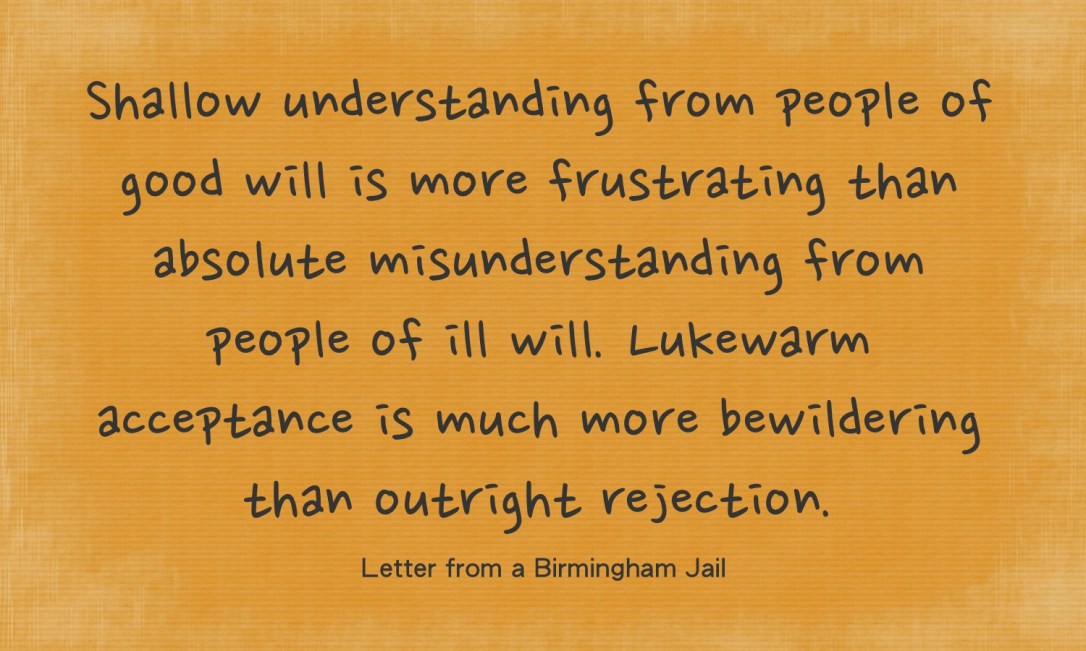
Sit with these nuggets from MLKs letter for awhile to see which stirs you most:

birmingham jail quote 2birmingham jail quote 3 birmingham jail quote 4 birmingham jail quote 5

King’s words are eerily relevant to the church today, and the whole book left me feeling that, in Grace Biskie‘s words, MLK Jr. would ‘facepalm at the state of things today’. Birmingham Revolution shows just how much the white evangelical church has sided with the safety and reason of the Birmingham clergymen rather than learning from courage and tenacity of Fred Shuttlesworth.

“Race is the gigantic elephant in the American living room that some insist will disappear if only we would just ignore it,” Gilbreath asserts. “For African Americans and other people of color, however, it is difficult to ignore a six-ton pachyderm when it’s sitting on top of you.”

I’m afraid that I can’t say I see much change in white people’s fundamental view toward race today than what MLK saw at the end of his life, “Whites, it must be frankly said, are not putting in a mass effort to re-educate themselves out of their racial ignorance,” he wrote. “It is an aspect of their sense of superiority that white people of America believe they have so little to learn.”

As a white person, there are times when I get the distinct impression from my culture that Martin Luther King, Jr., black history, civil rights, and the like are for ‘those other folks’.  What I was reminded afresh in Birmingham Revolution is that the story is just as much about us as it is about them.  We played half of this story, and if we care at all about adressing the issue of the elephant in the room, we need to learn more about how it got there in the first place.

Further Reading

Books, Families, Children & Marriage

The gift of seeing themselves: Strengthening children’s identities through multicultural literature

It’s quite likely that I can attribute roughly 30-50% of my faith to writers, and I must also credit the same to the growth of my understanding of culture. As a result, I have a special love for the beautifully told stories in children’s picture books, so multicultural literature has naturally played a huge role in our family’s life.  (Check out some of our favorites here.)  It’s been my way of helping our children to see both stories of themselves and others reflected in their lives.

One of my very-favorite essays on the value of children reading stories in which they see themselves reflected in the stories is written by Mitali Perkins, an author of quite a few young adult fiction books on children living between worlds.  I used to read it to classes of teachers-in-training that I taught and would swallow my tears every-single-time I read it as I felt the intense emotion in her words.  It’s one of those pieces that just never leaves you, and I’m quite pleased that she’s given me permission to share it here.

swirl

The Magic Carpet

by Mitali Perkins

I had a magic carpet once.  It used to soar to a world of monsoon storms, princesses with black braids, ferocious dragons, and talking birds.

“Ek deen chilo akta choto rajkumar,” my father would begin, and the rich, round sounds of the Bangla language took me from our cramped New York City apartment to a marble palace in ancient India.

Americans made fun of my father’s lilting accent and the strange grammatical twists his sentences took in English.  What do they know? I thought, perching happily beside him.

In Bangla, he added his own creative flourishes to classic tales by Rabindranath Tagore or Sukumar Roy. He embellished folktales told by generations of ancestors, making me chuckle or catch my breath.  “Tell another story, Dad,” I’d beg.

But then I learned to read.  Greedy for stories, I devoured books in the children’s section of the library. In those days, it was easy to conclude that any tale worth publishing originated in the so-called West, was written in English, and featured North American or European characters.

Slowly, insidiously, I began to judge my heritage by colonial eyes.  I asked my mother not to wear a sari, her traditional dress, when she visited me at school.

I avoided the sun so that the chocolate hue of my skin wouldn’t darken.  The nuances and the cadences of my father’s Bangla began to grate on my ears.  “Not THAT story again, Dad,” I’d say.  “I’m reading right now.”

My father didn’t give up easily.  He tried teaching me to read Bangla, but I wasn’t interested. Soon, I no longer came to sit beside him, and he stopped telling stories all together.

As an adult, I’ve learned to read Bangla.  I repudiate any definition of beauty linked to a certain skin color. I’ve even lived in Bangladesh to immerse myself in the culture.

These efforts help, but they can’t restore what I’ve lost. Once a child relinquishes her magic carpet, she and her descendants lose it forever.

My children, for example, speak only a word or two in Bangla.  Their grandfather half-heartedly attempts to spin a tale for them in English, and they listen politely.

“Is it ok to go play?” they ask, as soon as he’s done. I sigh and nod, and they escape, their American accents sounding foreign inside my father’s house.

“Tell another story, Dad,” I ask, pen in hand, and he obliges. My father’s tales still have the power to carry me to a faraway world. The Bangla words weave the same colorful patterns in my imagination.

My pen, however, like his own halting translation, is unable to soar with them. It scavenges in English for as evocative a phrase, as apt a metaphor, and falls short. I can understand enough Bangla to travel with my father but am not fluent enough to take English-speakers on the journey.

My decision to leave mother tongue and culture behind might have been inevitable during the adolescent passage of rebellion and self-discovery. But I wonder if things could have turned out differently.

What if I stumbled across a translation of Tagore or Roy in the library, for example? “Here’s a story my dad told me!” I imagined myself thinking, leafing through the pages. “It doesn’t sound the same in English. Maybe I should try reading it in Bangla.”

Or, what if a teacher handed me a book about a girl who ate curry with her fingers, like me? Except that this girl was in a hurry to grow up so she could wrap and tuck six yards of silk around herself, just like her mother did.

“Wear the blue sari to the parent-teacher meeting, Ma,” I might have urged.

Chocolate-colored children today have access to more stories than I did. A few tales originating in their languages have been translated, illustrated, and published.

Characters who look and dress and eat like them fill the pages of some award-winning books. But it’s not enough. Many continue to give up proficiency in their mother tongues and cultures.

“Here’s a story from YOUR world,” I want to tell them. “See how valuable you are?”

“Here’s a book in your language. See how precious it is?”

If we are convincing enough, a few of them might transport us someday to amazing destinations through the power of a well-woven tale.

swirl

This essay was originally published here.

Read more by Mitali Perkins

Miscellany

{an old love poem}


as i watched them plod slowly up the hill, hand-in-hand
(for steadiness more than romance), i began to see what
so many years of love and tears and laughter and anger
and struggle and joy give to those willing to face it together.
 
years later, i watched him weep when his steady companion
let go of his hand and took a step forward without him, and
again, i caught a glimpse of the depth of love that years of
walking faithfully side by side grows between two hearts.
 
their years together leave me with both tears and smiles,
hoping that i, too, will someday have seen just as many
loving and tearful and funny and angry and difficult and
happy moments of that-kind-of-love that lasts for a lifetime.
Culture & Race, Families, Children & Marriage

Why toys need to reflect racial diversity (Here’s lookin’ at you, Lego!)

Image credit: Chinian

Our change.org petition to ask Lego to make their minifigures more diverse is beginning to make the rounds on Twitter (Way to go to those who are sharing it – keep it going, especially on Facebook!), so naturally I’ve received some push back.  It made me think that my mama-bear reaction to fight for what benefits my biracial kids would also benefit from a more thorough reflection of the issue.

I distinctly remember the first time, nearly 15 years ago now, that I saw an ad on the wall in a Springfield, Virginia Wal-mart containing people who weren’t white.  It’s hard to believe now, but back then I did a double take because it caught me so off guard. As a white person, I was so accustomed to seeing only people who looked like me in advertisements that I hadn’t ever considered the fact that they only represented one portion of our country’s population.

A lot has changed in advertising in those fifteen years, and the change had to start from somewhere.  I appreciate the variety of voices who have spoken up for better, non-stereotyped representation of all sorts of people in mainstream media (no surprise that my new BFF is Cheerios!). While there are certainly issues far more serious and pressing than the color of Lego minifigures, in the process of pursuing justice, there are a lot of little stories that matter right alongside the really big ones.  I believe this is one of those little stories.

As we’ve raised biracial children, we’ve searched long and hard for toys and books that reflect a wide variety of experiences, backgrounds and perspectives.  It hasn’t always been an easy or successful effort, but it’s been an important way we affirm this piece of our children’s identity. As a result, while a few may view such a petition as ‘silly’, I view it as yet another small step toward leveling the playing field in our broken racial history, and an opportunity to tell a new story to our children.  Here are a few reasons why:

THE-OBVIOUS

1. Duplo already did it.  When my son was little, his aunt bought him a whole set of multiracial Duplo figures.  We loved them and are still waiting for the Lego minifigure versions.  Strawberry Shortcake, Dora, Diego, Backyardigans, Little Einsteins, Sesame Street, My Little Pony, Wild Kratts, The Electric Company and so many other brands incorporate characters representing a range of physical appearances. Why not Lego?

2.  People aren’t all one color.  Even if I could buy the rationale that yellow is a neutral color, there’s still the problem of Legos minifigures only reflecting one color. If Lego wants to keep with the ‘neutrality’ theme, then at least they could create a variety of skin tones – green, purple, blue, pink, etc. – if yellow is really neutral, then so are these colors.  Creating more hues would at least acknowledge that skin color varies among people.

3.  Children see yellow as a color for light-skinned people.  When you give children crayons to draw a picture, they reach first for peach to draw light-complected people.  If it’s not there, they pick yellow.  By creating only yellow-skinned figures, Lego leaves brown children wondering why they were left out and doesn’t allow white children to encounter anything but themselves.

THE-PHILOSOPHICAL

1. Children believe what they see.  There is a long history of studies tracking children’s views of race, a recent one being CNN’s doll study on Anderson Cooper that clearly shows both white and black children picking white children as “better, smarter, nicer, more behaved.” This study and many others highlight the need to positively reframe how all children understand and view race (not to mention other characteristics like gender and ability and economic status), and one way we can shift this from a young age is through the subliminal story their toys tell them.  

We need to ask ourselves if all children encounter representations of themselves in what they play with or read, and if they ever encounter representations of children who aren’t like them? When one color is dominant, it sends clear messages to both the privileged and the oppressed that the story isn’t changing for anyone. This story hurts us all.

2. Children internalize what they see. It’s no secret that light colors are symbolically good and dark colors are symbolically bad, but we need to pause to consider the deeper story this persistent symbolism teaches our children, particularly in regards to race. By making broad and intentional efforts to redefine the subtle stigma attached to the colors used to represent skin color, toy companies have the opportunity to tell children of all racial backgrounds a story of value for everyone, not just the light-skinned hands that have traditionally held the power.

3. We live in a broken racial story.  Probably the most concerning piece to me about the yellow Lego minifigures (and the predominance of white dolls in general) is the underlying story it tells our kids:  Valuable people are one color only – the lighter the better. This isn’t only damaging to all the brown children out there, but also to the white ones because it never disrupts their perception of the world as just-like-them.  

When people suggest that Lego mini-figures don’t have a race, they say it in the context of a world that has struggled under the hand of white racial domination for centuries.  This argument may have been valid in the Middle Ages when skin hue didn’t carry the historical baggage it does today, but this is not our story and we must live within the reality we have, not the one we wish we had. In a world that is rapidly globalizing, we are closer to one another than ever, but the decreasing distance doesn’t automatically produce increased understanding.  To dismantle this broken racial piece of the story we’ve told ourselves, we need to create a new one, one that does a better job sharing and representing power.

So in the end, while yes, making Lego minifigures in brown and peach and tan and butterscotch and caramel and chocolate and beige (or in purple and green and blue and pink and orange for that matter) might be a Little-Story, it’s the good Little-Stories that ultimately make up the good Big-Stories.  

The first time I saw someone who looked different than me represented in an advertisement, it made me pause and think, “Oh, yeah. There are more people than just me. Maybe I should consider them, too.” It was only a little story in a blip of my life, but combined with so many other little stories, it’s shaped my Big Story into a more beautiful one than I could have ever imagined.

All the little stories. They matter.  

Let’s tell them well – especially to our children – so that we can all tell a better Big Story someday.

Related Posts

Don’t forget!

Culture & Race, Travel

Foreigner at a train station

train station

What happens when you shift from foreigner to friend without actually moving to a place? Such has become my reality in Sri Lanka, my husband’s homeland, as we have travelled there repeatedly over the past 15 years. I wrote this reflection for She Loves Magazine on my experience of returning year after year to the complex and beautiful country where my family and I love and are loved deeply. While it is not our home, it remains a precious piece of our life together.

swirl

I enter the train station trepidatiously. A foreigner-with-fancy-suitcases-and-tennis-shoes, I stand out against the locals in a sea of sandals, sarongs and saris. We board the train without incident and peer out the windows, eager to begin our journey. The train jolts and lurches forward; we travelers settle in.

We peer our heads out of the windows, breathing in a combination of warm-wind and train-smoke. The train clacks and bounces, while the intensity of both the beauty and the poverty rolling past our windows leaves me silently choked up.

Filth.

How do people manage to live like this? I wonder. But they don’t appear to be asking themselves any such questions.

“The people seem happier here,” my ten-year-old daughter observed. I have not spoken with them – I don’t know if this is really true or not – but from my train window, I notice the same thing: there is a contentedness to simply be that I do not often see in my wealthy-and-developed-world.

Shop owners chat. Children walk alongside mothers. Three-wheeler drivers await customers. There is no urgency to hurry or consume or buy.

Who am I amidst this place? I wonder. My external trappings carry no label except white-and-wealthy-foreigner. There can be no other put-on identity – funky, classy, intellectual, hip – except for this very obvious one.

It is undeniable that I do not belong here; but in spite of this, I cannot shrug the sense of strange belonging that comes with being a foreigner-wife. I am not merely a tourist in short-shorts trekking the ancient ruins and soaking in the breathtaking shores, but a family member, returning to the same people journey after journey, eager to see the small changes, check out the new developments and embrace the arms that have held my babies. We may not share language or culture or skin or fashion, but we share the same love for the same hearts. This bond holds us steady.

swirl

Click here to finish reading at She Loves Magazine.

Culture & Race, Social & Political Issues

Dear ‘Merica: a Lament

When the Coke commercial began to play on Sunday, our Superbowl party of chatty adults and raucous children instinctively grew quiet.  We watched the striking depiction of America the Beautiful unfold with tears in our eyes, mesmerized.

After halftime, I checked in on Twitter, and learned that not everyone in the country shared our sentiments.  I sighed at comments like “We speak English here” and “Nice to see that coke likes to sing an AMERICAN song in the terrorist’s language” and cringed at hashtags like #wespeakamerican and #boycottcoke.

Inside, I ached on so many levels.  (That seems to be happening a lot lately.)

I ached first because I spend my days teaching English to the very immigrants you suggest don’t belong in the country. They are among the hardest working, most generous and kindest people I have ever met.  Contrary to your belief, they desperately want to learn English.  However, this isn’t always as simple as it may appear.

If English as a Second Language (ESL) classes are offered in an area, there are often long waiting lists, the class times conflict with work schedules, parents don’t have child care, or work 3 jobs to make ends meet and simply don’t have time.  Some, like many of you, have never had access to education and find learning a new language just as challenging as you would.  Many didn’t have the opportunity to learn English before they arrived in the US because they fled their countries with only the clothes on their backs.

All my students speak English to some degree, but it’s also no secret that English is quite a challenging language to learn, and everyone (including yourselves, I might add) falls somewhere on a spectrum regarding a complete and accurate knowledge of the language itself.  The issue is far more complex than a simple command to “Learn English”.

The other elephant-issue in the room is that even if immigrants learn English, they still speak their native language.  Just because they speak English doesn’t mean they don’t still use their own language.  It’s as much a part of who they are as being American.  Multilingualism plays a significant role in our national history.  Spanish predates English in the US, and there were debates in our early years if English or German would be the language of the government.  Pretending that English is the only language spoken is inaccurate at best and dehumanizing at worst.

My students love America.  They love its diversity and opportunity and potential.  Read it in their own words:

Screen Shot 2014-02-04 at 5.39.13 AM

From their optimism, you’d have no idea how much they sacrifice because they believe in and love this country.  Their children don’t know their grandparents or aunties or uncles or cousins or beloved friends. Professionals with advanced degrees and impressive work histories accept menial jobs simply for the privilege of living here.  They work long hours to provide, and then share what they have with a generosity that puts most native-born Americans to shame.

swirl

The ache also struck another, more personal chord because both growing up and living as an adult in the rural Middle, I frequently encountered these types of perspectives. They didn’t come from everyone, mind you, and gratefully not from my own family, but they are certainly a familiar part of my background.

Part of my family had roots in Appalachia that transplanted themselves to the hills of Southern Indiana and the other part were Swedish immigrant famers.  We all grew into ‘good ole simple Midwesterners’. While I am not exactly one of those ‘liberal-coasters’ you like to rant about, I am a rural Indiana girl who frequently rubbed shoulders with you throughout a childhood that includes sweet memories of listening to country music in pickup trucks, riding in a tractor with my grandpa, devouring my grandma’s sweet rolls, rolling down hills, adventuring in cow-pastures and wading in creeks with my cousins. When I left home, I discovered a great big world that reflected so much of the goodness I had seen in my own little square of it; but it wasn’t scary like the tales I had so often heard – it was astoundingly beautiful.

So while I disagree wholeheartedly with your perspective that diversity in our country is not beautiful, I also know you.  I know your names and your faces and your homes.  I have played tag with you at recess and cheered with you at football games.  I have been your neighbor, your customer, your colleague, your student, your teacher.  For so many of these reasons, I know that these tweets don’t exactly give the rest of the country a complete picture of all that you are.

I know that you have families you love.  Like tight-knit immigrant communities, you care for each other, bringing casseroles for new babies and plowing driveways in snowstorms without being asked.  You visit hospitals and sit on porches and wave at neighbors and help out friends in need, even if you don’t really have enough for yourselves. Yes, there are ugly-racists among you, people who hate and spew all sorts of ignorance, but they do not tell your whole story for many of you disagree silently, but restrain from speaking for fear of rocking-the-boat, not knowing what to say or being told to ‘just take a joke’.  Some of you may speak like this because it’s how you were spoken to or because you’ve never known anything different or because you don’t know or love anyone who is different from you.  I know there are reasons for your words that go far deeper than the 140 characters you express them in.

But your words hurt.  They scar and they maim.  I know this, too.

I know firsthand that you don’t easily know what to do with people who are not like you. Our biracial and bicultural and multilingual-but-English-speaking family lived among you in a tiny little cornfield town for 8 long and painful years, enduring glares and scowls, holding hearts and sighing wearily with the very-few-others-like-us.  You love yourselves well, but you did not love us at all. You ignored us in restaurants, ran us off roads, made threatening phone calls in the middle of the night. You kept to yourselves when we reached out. You shrunk back in silence when the ugly-racists raised their loud voice.

There were some among you, however, who countered your iciness. They brought us casseroles, visited us when our young child was in the hospital, helped us build swingsets in our back yard, chatted with us in the schoolyard and invited us to their homes for dinner. Even if they didn’t always understand us, they offered their hands in friendship, listened and loved well.  I will forever cherish their efforts to welcome us ‘strangers’ into their world.

Looking back, however, I so wish it all could have been different, that everyone in the land that gave me such a warm and rich and connected childhood knew how to welcome outsiders like they welcome insiders, that they applied the same fierceness of love they show their families to the newcomers among them.

swirl

These days, I lament how frequently I hear this story of us vs. them – a story that says everyone needs to be just-like-us-or-get-the-hell-out; a story that forgets that most of us were immigrants-learning-English ourselves not too long ago; a story that demonizes the other side without ever actually getting to know them.  While it is not a new story, it is a broken strain of what has torn our country apart, not one that has united it.

This insularity and close-mindedness some of you wear like a badge really looks like an ugly-monster-mask to the rest of us.  It hides your true self, covering up the goodness and beauty that is in you, too.  By standing against the diversity represented in the #americaisbeautiful commercial, you are protesting some of the very ideals of family and virtue and community you value so deeply yourself (unless, of course, you side with the KKK. In that case, we have other issues to discuss.)

It reminds me of this peculiar name our forefathers gave us: the United States of America.  Just as our families hold individuals of every ilk, what makes our nation most beautiful is the diversity within.  Together, we’re attempting to tell a collective story to the world that echoes, ‘We’re better together.’  

The big cities and the tiny towns.
The crazy liberals and the staunch conservatives.
The blacks and the whites and the in-betweens.
The mono-linguals and the multi-linguals.
The fifth-generation descendants and the fresh-off-the-boats.
The cornfields and the coasts.
 

This is why it was so beautiful to hear America the Beautiful sung in so many languages, and why I long so fervently to see the love I first learned in ‘Merica open its arms and embrace everyone in their midst instead of just themselves.  

You are better than this, ‘Merica.

Embracing is something you do way better than the city-folk who won’t even look at each other on the street. The country has much to learn from you if you’d just drop your masks and share the beautiful parts of your lives instead of these ugly ones for you, too, are part of the America-that-is-beautiful. Please, help us keep it that way.

With love and hope for a new tomorrow,

Jody

Related posts

Culture & Race, Families, Children & Marriage

Dear Lego: Yellow is not a ‘neutral’ skin color

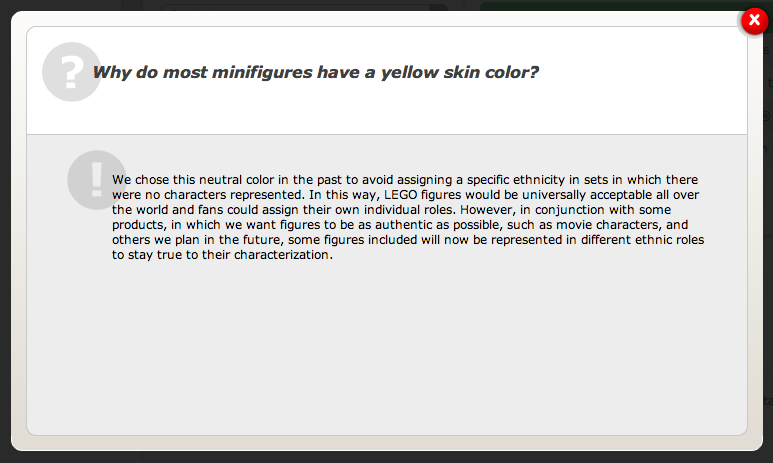
When my biracial son wrote this letter to the Lego company about the need for more racial diversity among Lego figures, I started thinking more deeply about the issue.  A friend of mine commented on Facebook that her son (now in his 20s) had written the company complaining that there weren’t any dark-skinned figures because he thought his dark-skinned cousin would feel left out.  At that time, Lego responded that they didn’t make different color mini-figures because “yellow was a ‘neutral’ skin color.”

I gasped.

Really, Lego?  

Have you ever given children a crayon and asked them to draw themselves?  White children use peach – OR YELLOW – for their skin and brown children DON’T.  Not ever. (Unless, perhaps, they wish the were a yellow Lego figure.)  Consider this picture my son drew of our beautiful family (I’m the peach one with the yellow hair.  He and his father are the brown ones):

family

I set aside my son’s offense temporarily until I went to the Lego website to submit his letter detailing his desire to organize his school into a strike against Lego because of the aforementioned ‘neutral’ yellow heads and, much to my great surprise, found this:

Screen Shot 2014-02-03 at 10.51.14 AMYes, folks, in 2014.  The centuries old narrative of one color dominating the world’s story needs to change.  Its hurting us all.

We now have a black president, 15% of marriages are interracial, over 20% of our country isn’t white, and that this figure is quickly increasing at a rapid rate.  Perhaps Lego missed the headlines that this is the world’s most typical – or in Lego’s words ‘neutral’ – person:

Screen Shot 2014-02-03 at 6.46.39 PM

Not this:

Screen Shot 2014-02-03 at 6.51.11 PM

Don’t get me wrong – I LOVE Lego.  I love their creativity and quality and imagination. That’s why it shocks me so greatly that such a genius company dismisses such a significant reality of its consumer market.  Consider with me a few facts about Lego:

  • There are about 62 LEGO bricks for every one of the world’s 6 billion inhabitants.
  • More than 400 million people around the world have played with LEGO bricks.
  • 7 LEGO sets are sold by retailers every second around the world. (Neatorama)

Here’s part of a fascinating infographic by visual.ly that gives specific stats about mini figures themselves:

lego

Let’s think about these stats for a minute:

  • If 400 million people around the world have played with Legos, it’s likely safe to assume that quite a few of these people weren’t yellow – or male for that matter.
  • Lego has corporate Lego offices in China, Hong Kong, Japan, Korea, Mexico, Singapore, South Africa, and Taiwan – none countries which have a sizable ‘yellow’ population (unless, that is, Lego cares to recreate the demeaning slurs of yesteryear).
  • If this many Legos and mini figures are being created and sold around the world at such a rapid rate, surely there’s enough market interest for Lego to create characters of varying skin hues, genders and ethnicities.
  • If one of Lego’s 4 most frequently asked questions posted on their own website is about the color of the mini figures’ skin, I’m clearly not the first person to ask this question. This mama-bear wants to know why the problem is being dismissed and not fixed asap. My son is growing up quickly and there’s no time to waste.

Step up to the plate, Lego.  Surely your unparalleled creativity can come up with a better solution that allows all children to see themselves in your toys given the remarkable history of innovation you have always shown.  Stop the excuses about yellow heads being ‘neutral’ – #werenotbuyingit  even the kids see straight through that one.  

swirl

Sign our petition to ask Lego to make their minifigures more diverse at Change.org.  Be sure to forward it along to your friends on Facebook or Twitter as well.  

Culture & Race

4.5 tips to help white people talk about race

carpe-2It’s no secret that race is a tough topic to discuss.  Given white people’s history of being both a dominant power and racial oppressors, it’s an even harder issue for us to discuss.  As a group, we tend to either stay quiet on the issue out of ignorance or fear or flip out and do horribly offensive things that make us look like racist-fools.

One of the most common reasons I hear white people say they don’t talk about race is fear of saying the wrong thing.  I know many, many people who don’t want to be offensive, but who also simply have no idea how to have a conversation on race because they’ve never had one.  They may care deeply, but without experience or understanding of race in their own lives, they bumble through such conversations, hoping for the best but not really knowing if they’re helping or hurting.

The tips on talking about race here will provide a starting point for people who want to be part of the solution instead of the problem, but who may not know where to begin.

1.  Listen.  In many race conversations, the dominant group is eager to share their opinions, views, or perceptions of how they see things.  They begin conversations by stating their questions, observations, or disagreements with a presumption of ‘rightness’, giving an unspoken impression that there’s no possible way to have a different perception than their own.  By participating in conversations first by listening, requesting clarification, and listening again, we communicate openness and allow ourselves to actually hear the reality of another’s experience instead of shutting down the conversation by becoming defensive, dismissive, or dominant.

2.  Learn.  Factually speaking, white people don’t have any idea what it means to live as a racial minority in a racialized society.  We can’t.  The simple fact that we’re white means we don’t experience racial prejudice firsthand in our homeland on a regular basis.  However, even if we can’t understand through our personal experience, we can attempt to learn more about what it means to see through someone else’s eyes.  With the sheer availability and accessibility of media today, we have no excuse to not read, watch movies, or seek out viewpoints outside of our own experience.  If we want to be a valuable participant in the conversation, we need to speak from a place of awareness, not ignorance.

One important point here is the need for white people to seek out other white people who are further along the path of racial understanding to process with in this phrase.  Quite frankly, too many eager-but-stupid-white-folk can be completely exhausting for the people of color who consistently have to dialogue about issues of race.  William A. Smith coins this ‘racial battle fatique’, a term which nails the overwhelming emotion many people of color face when they have to continually challenge others to acknowledge the realities of racism.  Most white people, however, have walked the lands of racial ignorance themselves at some point, and have an ability to understand and empathize with others just beginning the path.

3.  Accept.  Rather than assert an opinion, I’ve had more success accepting realities present in racial conversations rather than attempting to defeat or discount them.  These days, I find myself acknowledging my ignorance in conversations of all sorts of topics.  When I know my knowledge is inadequate, I’ll start a conversation with words like, “Forgive me for my ignorance here, but I don’t really know much about ___.”  and then I’ll ask for another’s perspective and do my best to listen well.  Admitting my ignorance from the get-go frees me to listen without trying to prove I know something.

Holly Daly, a good friend of mine with a long history of seeking racial understanding, points out that another reality white people would do well to accept is that the racial conversation does not have to be fair.   Many people approach a conversation with a feeling that the conversation needs to be ‘fair’, thinking consciously or subconsciously, “If I listen to your experience with racism, then you need to listen to mine and acknowledge that it’s equal.”

This attitude communicates an unwillingness to accept that we’ve received far more benefits for our skin color as opposed to prejudice. The fact is that race relations have never been equal in our country, and if white people want to be a healing factor in the equation of racial reconciliation, then we need to know how and when to surrender our own need for ‘equality’ in order to create places where the painful wounds of inequity have space to breathe, to be heard and to heal.

4.  Affirm.  While we will never completely understand what it means to walk in another’s shoes, we can affirm the reality of another’s experience.  Rather than dismiss another’s perception of racism, what if we simply affirmed the reality of what someone experiences rather than critique or question or explain away?  Phrases like, “I’m so sorry for your pain,” or “I can only imagine how that must hurt,” go a long way to affirm the experience of someone who feels marginalized.

4.5.  Love.  There’s one more point that I’ve found the most transformational, but adding a 5. will mess up my whole 4-theme, so I’m only counting it halfway because it’s not so much a tip as it is a magnificent gift because it cannot be forced or created, but something that arises organically and unplanned. By far the most life-changing way I’ve learned to speak of race is under the umbrella of love.

When you love someone, you should naturally do all of the above – listen, learn, accept, affirm.  And when you love someone of a different race, part of the process is listening, learning, accepting, and affirming this part of their experience as well.  I love and am loved well by so many people of color, and it has changed my world in ways I could have never imagined.  As they have spoken their truth out of love for me, I have learned about the fierceness of the human soul, about forgiveness, compassion, and healing in ways I’d never seen in my very-white world.  I am deeply indebted to so many who have loved me patiently and consistently across racial lines, for in loving me, they have shown me how to love more deeply.  This is, by far, the greatest gift that comes from our relationships.

swirl

In the end, while our efforts to grow in racial understanding won’t ever be perfect, there is still much we can do to humbly and boldly walk the path toward wholeness and restoration.  It’s time to stop our pattern of silence by talking, listening, and learning more about our role in the broken racial history of our world and intentionally pursue ways in which we can become part of the healing rather than continuing to contribute to the problem.

Related Posts

Culture & Race, Families, Children & Marriage

Dear Lego: Get your Butts to Work on Equality

Apparently, I’m raising a couple of activists.  My daughter was just complaining yesterday that Lego makes cool toys for boys and boring ones for girls, so there was much rejoicing in our house upon reading this letter that recently went viral:

Immediately after I showed this to my kids, my Lego-loving son son went straight to work on his own letter to the company.  When his older sister suggested that Mama might not approve of the ‘butt’ part, he responded, “Well, Mama says what she thinks, so I’m going to say what I think,” and proceeded to include his own vocabulary choice in his letter even though he knew it meant risking the loss of his precious screen time.  (Upon reading the letter, I thought it captured many children’s frustration with the company’s lack of attention to diversity well, so in this case we applauded his accurate choice of vocabulary and had a good little chuckle ourselves!).

He’s not one for beating around the bush, this kid.  His teacher recently told me that when his class was discussing the history of Native Americans, she made a comment along the lines of, “The Europeans did a few bad things to the Native Americans.” to which my son promptly responded, “Really?!?  Just a few???”

His keen mind sees straight to the core of so many things, and he captured another aspect of Lego’s bias so perfectly in his letter below that I couldn’t resist asking him if he would mind guest-posting on my blog.  He graciously agreed.  So without further adieu, I introduce to you my slightly sassy, ever truth-telling and fabulous 8 year old son, Jehan:

lego letterFor those of you not proficient in reading 8-year-old-handwriting, here’s a transcription:

Dear Lego,

I know you have to make white people in Lego, but I am biracial and I would like (and probably a lot of other people too) for you [to] make more dark skinned and Chinese legos.  I have never seen a Chinese Lego minifigure.  Now, if you don’t make these, I will ask me and my friends to go on a strike on Lego! So I mean now and maybe even my whole class!

So I suggest you get your Lego butts working or I will ask the whole school to do a strike on Lego.  Now my sister thinks I should NOT post this on Facebook, but a girl named [Charolotte] did, so I am!

Now I mostly play with girls.  I think girls aren’t all pink princesses because my friend Arie plays spies with me.  She has bows, guns, you name it.  Now, my other good friend Emma, she would like to have Lego girls too.  Maybe you could have a new form of Legos – Lego Adventure – Lego sales would go haywire.

From, Jehan

The-best-ones

The-best-ones-in-January

The-ones-about-race

Explaining white privilege to a broke white person by Gina Crossly-Corcoran.  “So when that feminist told me I had ‘white privilege,’ I told her that my skin didn’t do shit to prevent me from experiencing poverty.  Then, like any good, educated feminist, she directed me to Peggy McIntosh’s 1988 now-famous piece, “White privilege: unpacking the invisible knapsack.”

The ugly, fascinating history of the word racism by Gene Denby.  “Racism remains a force of enormous consequence in American life, yet no one can be accused of perpetrating it without a kicking up a grand fight. No one ever says, “Yeah, I was a little bit racist. I’m sorry.” That’s in part because racists, in our cultural conversations, have become inhuman. They’re fairy-tale villains, and thus can’t be real.”

The-ones-about-family

Ten reasons parents should read multicultural books to kids by Meera Sriram.  “Yet none of the books on display mirrored this heterogeneity around me. I stood there and wished books for children were much more eclectic and flavorful. I wished more books had stories in which I saw someone like the woman at the train table. Most of all, I wished these books were mainstream—powerful, influential and easily accessible.”

An open letter to my nieces by a laugh of recognition.  “There are so many things I want to tell you now, but you’re only 2 and almost 4, and we all know that the only things you want to hear from me right now are:  1) Yes, you can eat macaroni and cheese for every meal, chased with chocolate milk and ice cream for dessert. 2) Of course you can have as many puppies as you want. And they can sleep in bed with you.”

Growing up between worlds: Who am I? by Christie Wilkin.  “When my husband and I made the decision to move our family of six from Pittsburgh, Pennsylvania to Melbourne four years ago, it never occurred to us that our biggest dilemma would ultimately prove to be moving them all back home again.”

The things teenagers leave behind by Rachel Pieh Jones.  “My teenagers don’t live at home anymore and every time they go back to boarding school, every time they check-in under the Kenya Airways sign at the airport, I think, “How can something that is so good for them hurt me so deeply I can’t breathe?””

The-truth-telling-ones

Outlawed grief, a curse disguised by Jonathan Trotter.  “Living abroad is an amazing adventure, but it comes with some baggage. And sometimes, the baggage fees are hidden, catching you by surprise, costing more than you planned. You thought you had it all weighed out, you could handle this, squeeze right under the limit. But then it got heavy.”

The Fortress by Rachel Held Evans. “Sometimes I think we are less afraid of a powerful God than a vulnerable one.”

Evangelical drama needs mainline experience by Erik Parker.  “All Christians in North America, if they are paying attention, are forced to watch the Evangelical tribe as it rumbles and quakes about whatever is the issue of the day is. And I cannot help but see it all as some grandiose high school drama.”

Do it afraid by Tara Livesay.  “Fear. The real F word. Keeps us from trusting. Keeps us from risking. Keeps us from healing. Keeps us trapped. Keeps us from doing. It tells us lies: You are not good enough. It will be too hard for you. You will fail. It will be too painful. You cannot do it. You are alone.”

The-faith-filled-ones

How I rediscovered faith by Malcolm Gladwell.  “Their daughter was murdered. And the first thing the Derksens did was to stand up at the press conference and talk about the path to forgiveness. “We would like to know who the person or persons are so we could share, hopefully, a love that seems to be missing in these people’s lives.”

How to get through the dark places by Anne Voskamp.  “The accepted way professional runners approached the race was to run 18 hours, sleep 6, for 7 days straight. But Cliff Young didn’t know that. He didn’t know the accepted way. He only knew what he did regularly back home, the way he had always done it: You run through the dark.”

The-laugh-out-loud-ones

Airplane travel gives me gas by Rachel Pieh Jones.  “This is a post about air travel and gas, like stomach gas. And about air travel and crusty boogers. Air travel and stinky socks. Air travel and morning breath all day long. Air travel and a face so greasy-shiny my forehead is practically a mirror.”

It’s enough to make you cancel your reservations: Actual complaints from Thomas Cook clients.  “8. “No-one told us there would be fish in the water. The children were scared.”

The-beautiful-ones

The names they gave me by Tasbeeh Herwees.  “When I say my name, it feels like redemption. I have never said it this way before. Tasbeeh. He repeats it back to me several times until he’s got it. It is difficult for his American tongue. His has none of the strength, none of the force of my mother’s. But he gets it, eventually, and it sounds beautiful. I have never heard it sound so beautiful. I have never felt so deserving of a name. My name feels like a crown.”

These 14 response to hatred show that humans sometimes do get it right.  “Whether based on religion, race, nationality or sexuality, overcoming the made-up rivalries society thrusts upon us takes people with strong will, especially in the face of peer and societal pressures. And yet, humans are always capable of surprising us. In these cases, they rose above the prejudice and the hate and decided that some things are just wrong.”

Popular-on-BW

4 reasons white people need to talk about race.  “This cannot be a discussion of tit-for-tat, of accusations and defensives, and as members of the dominant majority, we need to lead the conversation first with humility and compassion.  We can not let go until we know what it is that we’re holding onto.”

4 reasons white people don’t talk about race.  “We can’t simply will ignorance away. If we want to increase our understanding, we have to do something about it.”

9 ways to help children develop global awareness.  “Since my husband spent half of his childhood in a developing country at war and the majority of his family still lives there, we were especially keen to help our children growing up amidst privilege understand these realities more deeply. We’ve made attempts at this in a variety of ways, hoping that a few of them will stick.”

Culture & Race, Restoration & Reconciliation, Spiritual Formation

Rethinking how we speak about American blessings

“We’re so blessed to live in this country.”

I cringe a little when I hear a statement along these lines, wondering about the sentiments that lie beneath the actual words.  I usually hear people respond this way in response to conversations about difficult realities like poverty or hunger or lack of sanitation or war.

Statements like this unsettle me for a variety of reasons.  When people say, “We’re blessed to live in the US,” sometimes I hear an assumption of superiority behind their words that portrays an attitude of we’re-so-much-better-than-those-poor-folks-in-the-poor-world.  It makes me wonder if focusing on our assumed ‘blessings’ of comfort, prosperity and sanitation allows us to numb out the feelings of horror, responsibility, and generosity we might feel if we actually let those realities of global poverty sink in.

Another reason these words unsettle me is because they passively imply that those in other countries aren’t equally blessed to live where they live. There’s a sense that we live in the promised land, and those poor folks – well, sucks to be them, eh?  On one level, I follow the idea that a developed and civil society is a more comfortable environment to live in.  Cleanliness, prosperity, order, and efficiency are good ideals that benefit society as a whole.  However, they certainly aren’t the only qualities by which the value of a place should be judged.

While I know a lot of people who’ve sacrificed immensely to move to the US, I also know quite a few who would never want to live here.  They don’t hate it, it’s just not home.  They feel blessed to live in their homes, with their food and their loved ones and their dirty streets and inefficient systems. They’re also horrified by our violence, materialism, sexual ethics, and isolation from each other.

A friend of my husband’s from Sri Lanka who’d lived in Singapore for several years recently told him, “Everything there is soooo clean and efficient and productive, sometimes you just need to get out to get a break or you go crazy.”  I chuckled when I heard this, for at the time, I was in Sri Lanka missing those very qualities about my American home.  Sometimes, it’s all about what you’re used to.

Don’t get me wrong, I love my homeland.  It’s taken nearly three decades, but I can even say that I love living here (California has helped this process quite a lot).  Driving across the country a few years ago gave me a whole new appreciation for its vastness, diversity, and beauty.  I love that the freedom here allows for a global mosaic like Los Angeles.  I love the sense of community the lingers in my heart from my small Midwestern home town.  I love the hustle and bustle of New York City, and the never-ending quietness of Kansas.  It really is a unique, diverse, and beautiful country.  

But there are a lot of such places around the world that people call home.  From the outside, we might perceive some of these places as destitute or hopeless, but this is not their only story.  I spent a summer once in Burkina Faso, one of the poorest countries in the world at that time.  The capital city, Ouagadougou, had two paved roads.  Disease and hunger were rampant.  At first glance, the people were destitute.  But then I looked again.

I saw old women with their heads wrapped in vibrant scarves dancing down the church aisles to give away the little money they had.

I saw bright eyes, curious to learn, fascinated by color, eager to smile at passersby.

I saw people sharing meals with each other, spending long hours together, warmed by each others’ presence.

I saw a generous hospitality that gave up beds, welcomed strangers, and cared for the sick and the poor.

I saw eager minds, grateful for the opportunity to learn and hopeful for the gift of an education.

There was so much good there that I would have never seen from a picture in a magazine of a bloated baby with flies in her eyes.  While their good didn’t look like my good, it was still very real.  They were blessed beyond measure, and I had so much to learn from them.  

When we hear about the hard-things-of-the-world, what would happen if we refocused our response away from our own comfort, safety and prosperity?

  • Issues of poverty seem so devastating, are there ways I could help alleviate it with the resources I have access to?
  • So many people go without, how could I simplify so I have more resources to share?
  • While it may look like a desperate situation, what is the strength of the people in it?  How can I learn from them rather than pity them?
  • If I live in comfort, are there people near me who don’t?  Do I see them?  How might they perceive the country I say I’m blessed to live in?

If we ask these questions first in our hearts, maybe our words would start to change too. Instead of responding that I’m so blessed to live in the US, maybe we’ll start saying, I love my home, and I have much to learn about how to see the blessings in the rest of the world.    And while we’re talking about it, maybe we’ll actually start doing it as well.

Let’s brainstorm new ways of speaking about where and how we live that honors the whole world, not just the US or the West. Have you found words/ways to do this?  I’d love to learn from how others speak about such things.  

Also, be sure to check out this post from Communicating Across BoundariesThe Problem with Blessing, to ponder the idea of blessing even further.  

Related Posts

Culture & Race

4 reasons white people don’t talk about race

carpe

As a follow-up to last week’s post 4 Reasons White People Need to Talk about Race (which I’d strongly recommend reading in tandem with this post), I want to explore further the general silence surrounding race within white culture.  

But before I go there, I need to confess that this is perhaps one of the hardest pieces I’ve ever written.  It was one of those that I tried to avoid every time I sat down to write.  I’d type three words and get up to make myself some tea, then remember I needed to change the laundry, then attend to some dirty dishes (which is significant if you know how much I hate to clean), finally returning to my screen to check Facebook, Twitter, and email before returning here to add just five more words and deciding I was far too tired to write and needed to go to bed.

It’s not that I don’t have anything to say and more that it’s just really hard to say it.  The likely reason that it’s hard to say is that all of these things below swirl around inside me to this day.  I’m not only pointing out holes in everyone else; I’m also pointing them out in myself.  Quite frankly, that’s not a whole lot of fun. 

With that in mind, I walk carefully through this complex, loaded, and painful territory, terribly aware of the reluctant awakening this journey holds for many like me.

swirl

There’s clearly a frustrated-curiosity out there regarding white people’s racial understanding given some of the search terms that direct people to this blog:

  • “why do white people dismiss black suffering”
  • “culturally insensitive white church”
  • “don’t trust white people”
  • “no idea about white people”
  • “don’t like white people”
  • “white people think they’re experts”
  • “white people don’t acknowledge me”
  • “white people talk like they know everything”

When I see these phrases, I can’t help but wonder if part of this is in response to the silence that surrounds race in many white communities.  Recent news stories illustrate this silence well.

Phil Robertson’s comments around race were just as provocative as his comments surrounding homosexuality, but this didn’t get near the coverage that it should have.  The lack of speakers of color at many conferences passively removes the race conversation from such venues.  Bring up race in a mixed room and watch as most of the white people morph into wallflowers.  After the Zimmerman verdict last summer, I had white friends who hadn’t even heard of the case.  Even though it was one of the most controversial racial cases in recent history, no one in their circles was talking about it at all.

As every person is an individual, there are likely a whole number of reasons for such silence.  However, the tendencies that run within cultures are still beneficial to consider if we want to deepen our understanding of what shapes our views on and reactions toward racial conversations.  While this won’t be a conclusive list, for the sake of conversation, I’d like to put a few reasons out there why white people don’t talk much about race for us to ponder together.

1. Fear of Conflict

Perhaps the most potent reason white people don’t talk about race is fear of conflict.  This can be fear of both internal and external conflict.  Jon, a commenter on this post, writes about the fear of conflict with others, “Yes, racism is real in the United States, as is privilege, but I think there has to be a way to deal with that problem without constantly having to take the posture of being apologetic so that everyone knows you’re not like those “other” culturally insensitive people.”

Jon’s comment summarizes well the fear that many white people of being wrong, looking ignorant, or saying the wrong thing in conversations about race.

Sarah Visser, a professor of leadership at Azusa Pacific University who studies diversity and white privilege, points out that this fear of conflict need not be only with others, “I think that often when we experience fear-triggers, we assume that it’s coming from someone or something,” she wrote in a recent email exchange we had on the topic, “when actually it springs from deep inside us and is evidence of our need to do some ‘personal work.'”

I learn this lesson time and again, not realizing the impact of a racialized society on my own thinking.  Years ago, I was teaching at a very diverse high school.  One of my best students was a tall African American male who faithfully submitted meticulous work, treated everyone with respect, and was well-known for his kind and gentle manner.  One morning, I was walking into school and saw a tall black male dressed in saggy pants, an oversized jersey and a cock-eyed hat from afar.  Instantly, I tensed because of the ‘gangsta’ image I perceived from afar.  As I walked closer, I recognized him as my beloved student.

Coming face to face with my subconscious absorption of society’s microagressions* toward black male youth, I was both shocked and embarrassed by my reaction, and it forced me to face the fact that, regardless of what I thought I believed, I was not at all immune to subscribing to stereotypes.  In order to deal with this stereotype I held, it was necessary for me to intentionally acknowledge it rather than remaining silent to save face, even if I was only acknowledging it to myself.

2.  Guilt

“I am tired of this guilty conscience mentality that people are trying to push onto “white” people,” wrote Joseph, a commenter in this post.  He is certainly not alone.  I have heard many white people express frustration with feeling forced to ‘take responsibility’ for past actions that they had nothing to do with.

Tatum (1997) suggests that this stems in part from white society’s understanding of themselves first as individuals in a meritocracy (p. 103).  In other words, we think we got where we are all by ourselves and that we deserve it.  This contrasts significantly with the fact that many people of color come from cultures with more communal perspectives who view their individual success rooted in the experience of those around them.

My husband has made a similar observation about how this individualism influences the white evangelical church in America.  From his perspective, this arm of the church disproportionately focuses on individual sins relating to sex like homosexuality, abortion, pre-marital sex while turning a blind eye to corporate sins like greed, lack of care for the poor, and preferential laws for the rich.

When we (white people) view ourselves as only individuals and not part of a whole, it’s easy for accusations of racism to induce guilt. It’s true – we didn’t do it individually. However, when we allow ourselves to learn from the perspective of communally oriented cultures, we’ll learn more about how the system was established to benefit us at the expense of others and how we continue to perpetrate this very system without intentional actions to change it.

As it stands, the system in which we quite comfortably live our lives tells our stories from our perspectives far more frequently than any others.  Ponder a few of these stories with me:

  • How might the ‘Thanksgiving story’ be told from a Native American perspective?  Could it be perceived differently than a peaceful dinner between the ‘Indian’ and the White Man?
  • Who frames the theological story we tell?  How would that story be told differently from those of a non-dominant power?
  • Where are our theories rooted?  If the research on which we base our understanding of ‘sound theory’ comes only from a white western perspective, what realities might we be missing?

While the white perspective shouldn’t be eliminated, for the overarching story to be accurate, it needs to include a wide array of perspectives that extends beyond the dominant group.

3.  Ignorance

“Part of the problem, I think (in America, at least), is the willingness of the minorities to KEEP themselves segregated.”  (Chris)

To put it bluntly, a lot of white people don’t talk about race because they don’t know how, or because they assume that just because they’ve had a few conversations or seen a few news programs, they know everything there is to know about the topic.

In college, I was on a committee to plan the Martin Luther King Jr. Day celebration on campus.  Our (mostly white) committee came up with the slogan, “Racism: Been there, done that.”  When we suggested our theme to the invited African-American speaker for the celebrations, she pushed back. “Oh no, you haven’t!” she countered, and she was quite right.  We thought that our willingness to say the word race meant that we actually knew something about it.  How wrong we were.

Chris’s comment above illustrates an ignorance that  many white people continue to believe.  We may believe it because 1) we operate on media driven sound bytes or stereotypes; 2) we don’t have actual friends of other races; 3) we rely on gut feelings rooted in our own experience and not fact; 4) we’re not listening to any experiences except those that reflect our own.  Chris’s assumptions in the above statement are factually wrong, but his views will never change until he starts to dig deeper than the reasons above.

We can’t simply will ignorance away.  If we want to increase our understanding, we have to do something about it.  Watch documentaries.  Read the resources listed at the end of this post.  Volunteer.  Listen without speaking.  Attend an MLK Day celebration or a Black history event.  Ask the hard questions not of others, but of ourselves.

4.  Subconscious Superiority Complex

That revelation came later. In my youthful days though, I had concluded in my White-Christian mind that all those (passive-) aggressive Indonesians and blacks needed to repent from their anger and that me quietly ‘forgiving’ them was the way to balance out the evil in the world. I would look at my WWJD bracelet and smile, all self-indulged. (Jobke)

Finally, I think part of my fallen culture as a white privileged male person is to use my power to control and fix things, and people. It’s quite likely that that’s a bigger part of my draw to working with people from other cultures than I’d care to admit. But I need to confess this, continually, and claim my call as faithfulness, not fixing. I fail. Maybe we need a WPA (white privilege anonymous: “Hi, I’m Kevin, and I’m privileged”). Actually, doing my own “white work,” and engaging privilege directly, is much harder for me than “serving” folks from other cultures. (Kevin)

If I get really honest with myself, I kind of like the position of racial privilege that comes with my skin.  This doesn’t mean that I cognitively believe I deserve it or that I’m better because of my race, but it is a reality in my thinking that I need to confront.

A good friend pointed out that another way this superiority complex shows up is when white people expect race conversations to be ‘fair’, as in “if I listen to your experience with racism, then you need to listen to mine and acknowledge that it’s equal.”  Sometimes, we just need to listen humbly and keep our mouths shut. The honesty about arrogance and power in Jobke and Kevin’s comments is a great starting point toward humility for us all.

Gary Howard wrote an insightful book for teachers called We can’t teach what we don’t know: White teachers, multiracial schools.  In the same vane of this title, we can’t talk about what we don’t know.  Until we’ve spend some significant time understanding both our own attitudes and the perspectives of others in the racial conversation, we remain only observers of the conversation, not true participants in it.

swirl

In Why do all the Black Kids Sit Together in the Cafeteria, author Beverly Tatum discusses the necessity of courage to break the silence in the race conversation.  “Silence feels safer,” she suggests, “but in the long run, I know it is not.”  Tatum recognizes that nothing will happen if she acquiesces to her fear of confronting the reality she sees, and that silence is ultimately not a beneficial response for herself personally or society at large.  Keeping quiet in the face of injustice has never hailed as a historical virtue.  

With gentle steps and hopeful hearts, may this be our ever-present prayer:

Give us awareness to let down our guard and lean into the fear that keeps us silent in racial conversations.

Give us courage to face our guilt by learning about how our cultural values shape our internal definitions of what is valuable.

Give us a desire to increase our knowledge through listening and learning to voices of those whose stories and whose access to power differ from ours. 

Help us acknowledge our propensity to hold tight to power by loosening our grip and looking always to understand before we are understood.

(If you’re not white, I’d ask that you pray this for us as you can.  The painful history of race has also left us a broken people, even when we don’t acknowledge it, and your prayers for us are deeply needed.)

What’s your take?  Have you experienced any of the above reasons for not talking about race?  What did I miss?  

Related Posts

Further reading

Sue et al. (2007) describe microaggressions as, “brief and commonplace daily verbal, behavioral, or environmental indignities, whether intentional or unintentional, that communicate hostile, derogatory, or negative racial slights and insults toward people of color.”

Tatum, B. D. (1997). Why are all the black kids sitting together in the cafeteria. New York, NY: Basic Books.

Books, Culture & Race

More than a tourist: Living deeply across cultures

DSC_1609When I first started to cross cultures, there was a distinctly romantic quality to every adventure – fascination with food and language and buildings and transportation and landmarks. I would inhale the smells and sights and textures with wide eyes, captured by the difference they represented. I would wrap my tongue around the words and sounds, attempting to capture some small meaning with my own mouth. Culture captivated me, and I drank it in with every cup of tea I shared.

As time has passed, however, this romantic captivation slowed, and I found that crossing cultures no longer carried the same zing it once did. In fact, it required more energy with each new encounter for I no longer entered ignorant about my own assumptions and inadequacies.  When I enter a new culture these days, it is slower, more observant, less enraptured. I walk carefully and quietly, curious but patient about the new realities I encounter. After nearly half a lifetime of loving across a culture, the exoticism of such differences is being slowly replaced by a simple expectation of normalcy and humanity.

Click here to read the rest of my guest post this week at Communicating.Across.Boundaries.

Culture & Race

4 reasons white people need to talk about race

carpe-1Hi.  My name is Jody, and I’m a white person.  

Over the years, this single admission has often felt like an Alcoholics Anonymous confession, a fact about which I can do nothing and for which I am slightly ashamed.  I have stood at bus stops on the south side of Chicago, desperately wishing for dreads and dark skin so I wouldn’t stand out so starkly.  I have maneuvered the streets of the developing world, greeted with “I lofe you, babeee” and “Taxi, madam” solicitations because of the color of my skin.  I have received unwanted but superior treatment to the locals because my skin defines me as a wealthy foreigner.

My whiteness is something I did not ask for, cannot change, and don’t always completely understand.  While I haven’t always been aware of the full implications of this trait in a racialized society, living between worlds has pushed me to grapple with my race as a significant shaper of my identity. As I began this process, there was a time when I was ashamed of the privilege it carried, angry and saddened over the history of racial supremacy and discrimination.   I hear this shame frequently from other white people, frustrated with feeling blamed, dismissed or responsible for actions-not-their-own.  In response to this post, Jason summed up a sentiment I often hear from white people:

I feel frustrated that I somehow inherited qualities based on what my race did or didn’t do, and that I have “responsibilities” to be a certain way to other races therefore. I feel people want me to feel guilty for who I am based solely on my race.

I’m tired of being the bad guy, the boring guy, the rich guy, whatever. I’m tired of being told I have no right to feel that way because others have it worse. I’m tired of being singled out, having to be taught how to be “culturally sensitive” as if I’m the only one who isn’t–which incidentally reinforces privilege. I’m tired of being told I can’t have a voice, an opinion.

Joseph articulately shared a similar opinion:

All that to say that assuming someone’s whiteness or blackness marks their cultural makeup and place in society does not further the discussion nor lead to constructive debate. The issue in claiming that white people should burden the responsibility is that we again draw swords for the wrong reasons.

We entrench ourselves in our values and take sides to eliminate the burden of guilt and point to a symbol, which has no clear identity, as the root of the problem. Respect, faith and personal responsibility should be a driving force in how people conduct themselves with any and every person regardless of race. We should not be subject to some noble obligation for the sake of cultural semblance. I challenge your presumption that being white requires some intangible burden to be carried. You assume that my whiteness defines me simply because I am white. It does not.

Comments like these are great examples of why white people need to talk about race more than we do.  Let me explain a little further:

1. We don’t know how to talk about race

It’s rare that I hear a white person use the word “black” in public settings to describe someone’s race without stuttering in the process.  Most white people stumble nervously over themselves when using racial terms, “She’s a-um-a, well, she’s af-, bl-um, she’s blackImeanAfric-um, I mean, African-American?”

Yeah.  Let’s just be honest…I know I’ve done it.  And I know that chances are most of you white folks reading this have done it too.   We’re uncomfortable using racial terms because we don’t have to think in racial terms on a regular basis.

People of color talk about race all the time – they have to in order to negotiate living in a world where the dominant power structure does not recognize cultural norms outside of their own.  When race is a daily factor in human relations, people develop a language and ability to process it. However, because white people remain so silent on the issue, we often don’t have a clue how to talk about race with someone from a background different than our own.

2.  We don’t know who we are

I (along with plenty of other scholars) would argue that one of the reasons we defend ourselves so vigorously is because we don’t fully understand ourselves and the racial dynamics that shape our perspectives.  In her landmark book on racial identity development Why do all the black kids sit together in the cafeteria?, psychologist Beverly Daniel Tatum (1997) explores the development of white identity.  She suggests that the silence on race in white communities stems from the fact that white people see race as something as a defining trait for other people, not themselves.  As one white student commented, “I’m not white, I’m just normal.”

Tatum then goes on to explain the stages of white identity development, something I’d never even heard of until my college years.  My first encounter with my whiteness was when I participated in an urban studies program on the south side of Chicago.  We privileged and white college students lived in a rehab center with recovering drug addicts, all of whom were urban African Americans.  Completely unaware of the cultural rules by which I operated, I dove into seeking relationship with the residents, eager to learn more about their lives.  I asked all sorts of questions and listened eagerly as they shared their stories with me, a naive rural white girl.

I thought I was maneuvering just fine until the day, a woman named Pat approached me and said, “I need to apologize to you. I’ve been avoiding you the whole time you’ve been here.”

I froze inside, wondering what I’d done wrong.  I thought I’d been so nice, listening, smiling, asking questions. People where I came from were rarely so blunt, and I wasn’t sure how to respond to her bluntness, so I just continued to listen.

“You asked so many questions, I felt like you were some journalist pelting me with questions,” she explained.  “It didn’t feel like you really wanted to know me, just like you wanted to use me for my stories.”

I thought I might cry, both from her misinterpretation of my intentions and my lack of understanding about how my actions were perceived.

“So. I’m sorry,” she said. “I’m sorry I didn’t give you a chance and just shut down on you instead. It wasn’t very nice of me.”

I stumbled through some sort of response, but mostly I was speechless because I really didn’t know what to say.  It was the first time I’d come face-to-face with a person whose cultural rules dictated different values than mine, and I hadn’t even known I’d been operating by cultural rules.  In my mind, I was just “being normal”.

Come to find out, “normal” isn’t the same for everyone.  Gerald Pine and Asa Hilliard (1990) explain some of the underlying dynamics shaping our differing communication styles.:

Discussions and debates about racism create anxiety and conflict, which are handled differently by different cultural groups.  For example, Whites tend to fear open discussion of racial problems because they believe that such discussion will stir up hard feelings and old hatreds.  Whites tend to believe that heated arguments about racism lead to divisiveness, loss of control, bitter conflict, and even violence.  Blacks, on the other hand, believe that discussion and debate about racism help to push racial problems to the surface – and perhaps, force society to deal with them.

When I hear whites portray themselves as ‘colorblind’, I think of myself in those days, unaware and shielded from the harsh realities surrounding race and privilege as well as the different values by which I operated.  I think of the friend who said to me, “If you don’t see my color, you don’t see me.”  I think of all the people like Jason and Joseph who feel silenced in the race conversation because they feel blamed or pigeon-holed.  I think of the intense individualism by which white mainstream America unknowingly operates that conflicts with the communal value systems of other races and cultures.

And then I think it would do us all a whole-lot-of-good to talk about these things far more than we do.

3.  We need healing, too

Oppression does not only hurt the oppressed, it leaves deep scars on the oppressor as well.  Silence breeds shame, and the silence about our history as racial oppressors has allowed our shame to work its way so deep we don’t even see how it eats away at us.  Some of us even find it funny when it shows up in our private-little-racial-jokes or shock jock personalities like Rush Limbaugh.  Occasionally, it slips out to the public and there’s a collective gasp, a scurry to apologize, and red faces.

Quite frankly, sometimes it all feels like one big messy subject, a conflict too painful to solve, more divisive than uniting.

But Parker Palmer’s words linger in my heart, “We think the world apart, what would it be like to think the world together?”  To me, this is where healing for everyone begins in this complex conversation; and to think the world together, there needs to be two participants in the conversation. If we truly want to see change (which I believe many of us do), it can’t just be the people of color who are vested in this issue.  When white people “participate” in the conversation by smugly crossing our arms, silently observing from a distance, assuming we know better or arrogantly refusing to consider to other perspectives, we only perpetuate the system we’ve created.

4.  We’re afraid of losing control

This conversation about being the majority race can certainly grow complicated, and sometimes we can be so caught up in subconsciously defending our long-standing position of power that we’re unable to actually discuss the issues in earnest.

If we do want to discuss the issues, we need to start with ourselves and the history that frames the reality of our lives. While I value his honesty, I’d challenge Joseph’s notion that our whiteness does not define us by suggesting that in order to effectively and compassionately participate in society today, we need to spend time first understanding ourselves in relation to others by contemplating questions like this:

  • Who do I know?  Are my social circles made up of mostly people just like me?  If so, have I ever really listened to someone’s story that does not reflect my own?
  • How do I respond when someone presents a perspective I don’t understand?  If I am defensive, dismissive, or angry, what does their response trigger in me that makes me unable to hear their story?  How might I learn to respond with more compassion?
  • In conversations about race, do I listen or do I preach?  Do I assume first that I am right? Do I follow Stephen Covey’s model to listen first to understand, then to be understood or do I leave the conversation before I even consider the other participant’s perspective?
  • What do I know about my history?  Where do I come from?  What shapes my subconscious values and rules?
  • What do I know about the history of other races and cultures?  How do I know this history?  Was it told through the eyes of the culture itself or the dominant culture?  Could there be another perspective than the one I’ve seen?
  • If race comes up in a conversation either positively or negatively, do I speak or remain silent?  Why do I respond the way I do?
  • If I feel afraid or guilty in race conversations, how have I dealt with these emotions?  Do I allow them to immobilize me or do I lean into them as opportunities for deeper growth?

This cannot be a discussion of tit-for-tat, of accusations and defensives, and as members of the dominant majority, we need to lead the conversation first with humility and compassion.  We can not let go until we know what it is that we’re holding onto.

swirl

I’m Jody, and I’m a white person.

This is not my only identity, but it is certainly a piece of it.  The more I understand how it shapes me and, in turn, how this affects those around me and in the world-at-large, the more I will become a peace-maker rather than a conflict-instigator.

Will you join me?  

The road is long and the journey a bit bumpy at times, but the destination is one of vulnerability, hope and restoration. Let us not shut our eyes, our hearts or our mouths, but rather open them to those around us, creating space for everyone in our midst, not only those just like ourselves.

Related Posts

Further reading

Comment Policy

This is a painfully loaded issue posted in a moderated public forum.  Comments are welcome, but please be sure to carefully read the post first and then thoughtfully respond.  Knee-jerk reactions and hasty accusations are rarely productive in potentially explosive conversations.  It may also help to read this post before commenting.  Comments that do not follow these guidelines will not be published, though it is highly likely that these commenters will receive a personal email from me so we can dialog in a more private arena. While it can be ironically cleansing for the shit to hit the fan, it’s not particularly helpful to fling it all over everyone else.

Pine, G. & Hilliard, A. (1990).  Rx for racism: Imperatives for America’s schools.  Phi Delta Kappan, 593-600.

Tatum, B. D. (1997). Why are all the black kids sitting together in the cafeteria. New York, NY: Basic Books.

Families, Children & Marriage, Travel

The value of traveling with young children

trainI watched my children peer out of the bouncing train’s window, absorbing the views and smells and sights of Sri Lanka. In a sense, it was not at all a ‘new’ place to them – we have traveled here to visit grandparents and aunties and uncles and cousins every few years since their infancy.  But in another sense, it is a brand new experience every time we come because with each trip, they know more, understand more, process more.

The sites from the train whizzed past us, poverty violently contradicting beauty, and I watched my children’s reactions to this just as carefully as I watched the scenery passing by.

DSC_2069 DSC_2050 DSC_2066 DSC_2081These were not views we saw regularly in our lives at home.  On the train, their strongest reaction was quietness (which is significant if you know my chatty son), and they didn’t say much about it at all until we came back to the States.

Two days after our return, my son climbed in the car after school and commented, “Mama, I think I’m just really into the world,” he declared matter-of-factly.

“What do you mean by that?” I’ve learned it’s best to always ask him for further clarification.  He has a bit of a history of mind-stretching conversations.

“Well, you know.  All the kids at school, they’re really into video games and stuff.  It’s all they talk about.  Me, I think about other things, like poverty and stuff.”

The views from the train entered my mind, and I waited for more.

“I mean, can’t someone do something about it, Mama?” he asked the very question I asked every single time I see injustice.  “Why do people have to live like that?  Can’t Barack Obama help them?”

I rejoiced for the awareness he showed and smiled at innocence.  Those train-views were sinking in, and he was starting to sort them out.

My intuitive daughter made a different kind of observation, “The people seem happier there, mama.”  Already she senses the emptiness of accumulation and busyness, noticing the up-side of living without.  My father-in-law used to say that it takes a long time to see the good in a place like Sri Lanka, but she sees it without delay.

Over the years, I’ve had my moments of wondering if we’ve been crazy to repeatedly take our children to a developing country plagued by war, dengue fever, and flying cockroaches.  When they were babies and toddlers, I was nearly convinced we were crazy.  Nine hour jet lag didn’t look too great on any of us except my energizer-bunny-of-a-husband in those years, and it would be a bit of an understatement to say we had some rough moments on those trips.  So why do we embrace the difficulty, the seeming risk of it all?  

One of the strongest lessons I learned when my husband and I were dating was to make decisions out of conviction and not fear. I’ve carried this concept with me into parenting, and it has helped clarify many decisions – especially the idea of traveling with our kids.  Though we don’t always live close by, we value our families deeply, and want our children to have the opportunity to know and learn from them.  This value of family connectedness held more conviction than my fear of bombs or dengue or flying cockroaches.  While the conviction didn’t erase the fears, it certainly put them in perspective.

In the earliest years of parenting, our decision to travel with our children was merely a hunch that it would be good for them in the long run.  “Start as you mean to go on” became our motto, for we wanted the world to be something that was as much a part of them as their hometown, and we knew that to do this, it should be something they had always known.

As they grow up, periodic responses like my son’s are confirming our hunch.  Trip after trip, I watch them connect with bits of themselves that they can’t find here in the US.  I rejoice quietly when I hear them use mulli and akka (the Sinhala words for little brother and big sister) for each other, when they call their father Thaathi with a Sri Lankan accent instead of an American one, when my daughter asks me to put her hair in a really low ponytail because “that’s how a lot of people wear it here”, or when they critique each other on proper finger-eating techniques.  While these are small and simple details, to me they speak loudly that our children are embracing all sides of themselves, proud to be shaped by both sides of the world.

They are by no means walking this path between worlds perfectly – their penchant for pizza and entertainment rivals most kids – but they’re doing it well, leaning in with whole hearts and open eyes.  It’s the sort of thing that brings a mama to her knees, grateful for the chance to walk alongside the unfolding of wonder and compassion.

Related posts