Belief

The wild and sweet conflict of Advent

Christmas songs are supposed to be happy. Jingle bells ringing, happy people singing, red noses shining, and bringing good tidings – that’s the epitome of the Christmas spirit – right?

In many moments, I share this joyful sentiment. I love the wonder and anticipation of the season and how Advent invites us to pause and reflect. But sometimes, simple acts like reading news of war or chatting honestly with a broken friend leave me relieved that sentiments like Henry Longfellow’s make it into the season too:

And in despair, I bowed my head:

“There is no peace on earth,” I said,

“For hate is strong and mocks the song,

of peace on earth, good will to men.”

Written near the end of the civil war after the tragic death of his wife and serious injury of his son, I can only imagine the grief that shook Longfellow’s heart. “How inexpressibly sad are all holidays,” he wrote the Christmas after his wife’s death. “I can make no record of these days. Better leave them wrapped in silence. Perhaps someday God will give me peace.” Three years later, he penned the words to the beloved carol, I heard the bells on Christmas Day.

Silent.

Expectant.

We might all be better for it if we walked through advent like this. Certainly all of our hearts carry unmet longing and unresolved burdens, even through a seemingly joy-filled season. I fluctuate somewhere being parading my longings and burdens boldly before God and scrambling to cover them up so no one else can see my lack…

Perhaps Longfellow felt the same way that Christmas morning when he heard the bells ringing the old and familiar carols.

…and wild and sweet, the words repeat of peace on earth, good will to men.

For even if the song of peace is sweet, it can still be wild, elusive, unpredictable and uncontrollable. And even if good will to men runs wild, it can still hold an underlying sweetness, immeasurable pain interwoven with threads of hope and goodness. The sweetness of the season rings through warm moments, celebratory spirits, joy-filled children. But the wildness is just as present, highlighting the very present conflict of unresolved tensions, global injustices, misplaced priorities, feelings of grief, and pressures of holiday obligations.

These incongruous realities of advent prompt us to quiet our spirits and listen rather than to numb them with busyness, to seek hope through meaningful actions rather than chase happiness through meaningless objects. They beckon us to live quietly yet expectantly in a world of crashing noise. In the quietness, we can pray simple words like this:

May we return to the breath and the silence.

To the breath that gives us life,

To the silence where we hear God’s whispers.

May we weep for the brokenness of our souls,

And cry out against our distractedness.

May we return to the eternal God,

Whose love fills every fibre of our being.

(Christine Sine)

.

Come, Lord Jesus. We eagerly await your arrival, wild and sweet.

swirl

This advent reflection was originally posted on my friend Amy’s blog, Making all things new.

Belief, Social & Political Issues, Spiritual Formation

Where my treasure is

IMG_20131004_142656

Materialism is not a welcome subject to my ears. Ask my opinion on the matter, and I silently wish the word itself did not exist. It is a loaded subject for me – full of implications with which I would rather not deal. I am a product of the American dream. I work hard and “deserve” special treats on occasion.

I.really.like.shoes.

So I attempt cover-ups, convincing myself that I am not materialistic, I am simply taking care of my well being (and my feet).  In spite of my best efforts to ignore my materialism, it is slowly (and by that, I mean s-l-o-o-o-o-o-o-o-w-l-y) become something I protest within.  

On a global scale, modern protestors decry materialism because it reflects an imbalance of power existing in the world. While I don’t disagree with their arguments, my protests against this vice are more personal: the strangling grip it has on my soul.  

In spite of my best attempts to avoid acknowledging my own materialism, I battle it on a regular basis.

  • The homeless man on the corner holds a tattered sign that reads, “Hungry.  Will take anything,” and I clutch a little tighter to the granola bar in my purse before rolling down my window to give it to him.
  • Asylees who have fled their countries, leaving everything behind to relocate in a new country tell me their stories of separation and adjustment to a new life as  I battle the impact of how listening to their stories messes up my tightly arranged schedule.
  • I see photos of refugees posing with their most important thing and then head on over to Zappos to check out some new shoes.

I have no excuses for my actions.  I am a paradox.  I care, but I don’t.  My heart aches at poverty, but my actions value my own comfort more. The world’s need undoes me, but if it makes my life inconvenient, I blissfully ignore it.  

Sometimes, I white-knuckle my way past the lure of materialism by denying myself every slight pleasure. Other times, I throw my hands up in the air and go on a really great shopping spree. 

swirl

The shock sunk slowly in as I heard my husband’s voice on the cell, “The airport has been attacked.”

I was running errands, navigating the busy streets of our metropolitan home, and for the life of me couldn’t figure out what airport he was talking about.

Then it hit me.  We had returned three days before from my husband’s home of the war torn island of Sri Lanka.

While there, we didn’t think of it as “war torn”, but “home”. Suddenly, though, “home” for me had become a war.

A short three days after our departure, terrorists had invaded the country’s only international airport and had incurred over $300 million damage. The attack commemorated the 1983 riots that had launched the beginning of a 25 year civil war.

The media reports such atrocities so often that it is easy to become calloused. Yet for me, this was different – it was up close and personal, a place I knew with my own heart and hands and feet. It held beloved family members, cherished memories, deep attachment. Having grown up in the relative stability of Midwestern America, facing the devastation of war was way outside of my frame of reference. While I have traveled in many developing countries, wrestled intellectually with issues of poverty and injustice; the ever-repeating story of violence, corruption, and fear had never crept so close to my own heart. 

Although many disturbing images surrounding the terrorist attack crept into my mind, the most personally convicting was that of my own struggle against materialism. A strange (and perhaps egocentric) connection, I know, but I’m no longer speaking solely of the materialism associated with houses, cars, clothes, and the like, but of those unseen things in the material world that I routinely place in the box of “fundamental rights” – conditions I deserve by very nature of being human. 

Personal safety, physical comfort, financial opportunity, and convenience rose quickly to the top of the pile as I examined what I feared losing had I been in the airport three days prior. Though physically intangible, these very material commodities are a large part of the world to which I am inextricably bound. I just happen to live in a place where I have the option to numb out such realities by buying a pair of shoes.

Certainly God does not ask everyone to live in a war torn country. Yet he does allow difficult circumstances in the lives of all his children at one point or another, whether they be facing the death of a loved one, coping with chronic illness, losing a job, moving to a different city, or dealing with a difficult family member. Perhaps one step toward surrendering materialism lies in our response when these difficulties arise. In my life, this surrender plays out by letting go of the notions of my “expected rights.”

I must ask, “Who am I, really? Who am I that I should not have to face the ravages of war (or illness or financial collapse or the loss of a home I love or a sick child)? God may not ask that of other people, but if God asks it of me, am I willing to face it and not run away?”

[Gulp.]

The ramifications of these questions run so deep that I shudder to imagine what the future might hold if God really asked such things of me. And yet, God asks these questions of each and every one of us – not always about such extremities as war, but about our own unique tragedies of life.

swirl

At times, much of the Western church reacts to materialism just like I do.

Run. Hide. Rationalize. Ignore. Spend money on myself.

Sadly, as we continue to order our world with more things and self-centered expectations, I fear these actions will only lead us toward more confusion, distraction and disillusionment. In sitting with the scriptures, I am confronted with three attitudes that often hinder my ability to confront materialism: greed, fear, and pride.  

Greed

“Where your treasure is, there your heart will be also.”

Jesus spoke emphatically against the greed of our hearts in this world, pushing us to examine what use it would be to gain a whole world of material possessions, and yet still lose our souls (Mark 8:36). He cautioned us to keep free from the love of money, and to be content with what we have (Hebrews 13:5).

Living in a wealthy society, it is easy for me to rationalize my materialistic habits. To many American eyes, I am not the poster child for materialism. I’ve stayed at home with our kids, sacrificing salary by working flexible, part-time jobs. My husband is a professor, and we live on a modest income. We rent a small house and drive practical cars far longer than we’d like to. We budget carefully, pay off credit cards, tithe regularly, and prioritize spending. 

Yet when I examine my life in light of global reality, I see how tightly I hold onto the material aspects of my life, meager that they are. I hang my head, ashamed of what resides within. Jesus’ words pierce my heart, and I am forced to reevaluate the conditions of the faith I offer Him.

Fear

Fear takes on many forms, some quite subtle. It drives me to surround myself with things and live in environments that protect my insecurities. By focusing excessively on the management of both my possessions and the comfort level of my life, I build a fortress around myself rooted in earthly things, not godly ones. 

This is why Paul challenges us to pursue godliness with contentment (1 Timothy 6). By reminding us that we brought nothing into the world, and can take nothing out of it, he challenges us to pursue fulfillment in our Creator and not to use possessions to mask the fear that God alone cannot truly satisfy.

Another way I distinguish my fear of being unfulfilled is by examining my level of contentment. Whether I worry about how to pay the bills (and there has been plenty of that), if I look fashionista enough (or if the cellulite is taking over for good), or what kind of car I drive, each concern reflects a lack of contentment. And each lack of contentment reflects fear that God cannot, or will not, care for my needs. 

In reality, I do not deserve the safety or convenience or comfort of this country one ounce more than a Sri Lankan child caught in the middle of crossfire. While my intellect may agree with this statement, my materialistic mindset subtly convinces me that living in a physically safe environment will preserve not only my body, but also my soul.

Pride

Just as the Pharisees’ pride blinded them to the Messiah, so this same pride blinds me to the grip materialism has on my soul. When Paul writes that he has learned to be content in whatever circumstances he is, he speaks to being content both with humble means and in prosperity, both in being filled and going hungry, in having abundance and suffering need (Philippians 4:11-12).

In the frustration of combatting materialism, some may find it oddly tempting follow Jesus’ challenge to the rich man of selling everything we have and giving it to the poor (Luke 18:22-23). In such a vague issue, it can often feel easier to go to one extreme or the other rather than balance precariously in the middle.

While God legitimately asks such aestheticism of some people, for most of us the more difficult task lies in Paul’s lesson to the Philippians. He acknowledges his powerlessness to determine both the good and bad of life, and places himself in a position to trust God by seeking contentment regardless of his external circumstances. In a similar way, pride threatens contentment by creating either 1) a sense of entitlement to what we have or 2) a sense of superiority because of what we have given up.

swirl

Every era has a currency that buys souls,” writes sociologist Eric Hoffer. “In some the currency is pride, in others it is hope, in still others it is a holy cause. There are, of course, times when hard cash will buy souls, and the remarkable thing is that such times are marked by civility, tolerance, and the smooth working of everyday life.”

Upon close examination, what buys my soul and what buys the soul of a Sri Lankan suicide bomber may not differ as I much as I would like to imagine. In fact, my soul is probably bought with much less sacrifice.

Where does my treasure lie?”, I sheepishly ask myself, feet shuffling, eyes to the ground. If I am unwilling to face the answer to this question, I am equally unwilling to acknowledge where my heart and my soul lie as well.

Related Posts

Further Reading

Belief, Culture & Race, Restoration & Reconciliation

When light shines on the ashes

IMG_20130923_184110

There was a fire in the mountains close to our house last week.  The smoke clouds billowed both beautiful and haunting overhead, and we all held our breaths as we watched the helicopters dash back and forth over our neighborhood.  It’s an unnerving reality that comes along with copious blue skies and rare days of rain here in southern California.

swirl

I posted a heavy hearted passion here in this space several days ago, and it’s created all sorts of difficult and good conversation.

Like a wildfire, the charred remains that we’re fumbling through leave my soul a little bare. But the potential for new growth makes my mind run wild.

It was an unusual gloomy morning when I drove to work yesterday.  I rounded a corner to look up and see that the only ray of sun boldly breaking through the clouds was beaming down on that burnt part of the mountain.

“That’s pretty,” I thought, and turned the corner.

swirl

This morning, burdened and deep in thought, I once again saw the same scene at the same corner.

Cloudy sky.

Burnt mountain.

Ray of sun shining down brightly on the ash-covered part of the mountain.

Apparently I hadn’t gotten the message the first time.

“Don’t forget: I see the ashes,” my heart heard that still, small voice.  “I will shine my light on the burnt places too.”

My soul sighed, my grip loosened, and I grinned, grateful for the small reminder that it’s not my job to rebuild what has been destroyed, only to look for where the light shines.

Belief, Restoration & Reconciliation, Spiritual Formation

Living with purpose: Welcoming the stranger

The practice of ‘Welcoming strangers’ has been a part of my heart for as long as I can remember.  Somewhere early on, Matthew 25’s call to see Jesus in the faces of strangers took root deeply in my heart.

If I’d grown up in suburban Los Angeles where I now live as an adult, I suppose it would be normal for my childhood best friends to have come from all over the world.  This was not the case, however, in small town Indiana.  Yet from my youngest years, I was drawn to people who were outside of the mainstream.  From kindergarten on, some of my best buddies were Mexican, Swedish, and Finnish.  In high school, my friends used to tease me that they’d likely all marry local boys and I’d marry someone from halfway around the world.  No one was particularly surprised when I married a man from Sri Lanka.

It wasn’t only immigrants who caught my attention.  I would cringe in high school when I saw the cool kids torture the uncool kids.  Sometimes, I’d leave my friends at lunch to sit with the ‘reject’ because it saddened me to see them alone.  In church, my eyes look first for who doesn’t fit, rather than who does. I ache when I hear stories of people of all backgrounds who feel ostracized for their differences and long to find ways to help them feel heard.

Welcoming the stranger plays out in my life today as I guide students through the crazy-land of the English language and American culture, as I teach my children to bring in those around them, even as I pray for the same homeless man I see regularly around town. When my heart sings to take freshly baked banana bread for the new Chinese family down the street whose daughter has made friends with mine, I know I am walking the path laid specifically for me.

Having spent the last year being the ‘new kid’, I recently watched my daughter develop her own ability to welcome strangers.  This year, she came home delighted to learn that the previously mentioned Chinese neighbor girl was in the class just next door to hers.  When another friend didn’t want to play with the new girl at recess, my daughter looked at her straight-faced and responded, “We were both new last year, so we know what it’s like.  I won’t leave her out.  She needs friends,” and stood her ground while her friend walked away to play with someone else.  My mama-heart soared to hear her practice the joy of welcoming strangers.

Identifying my life purposes has come slowly over time as I pondered stories that stuck with me and captured my heart.  I learned to pay attention when I felt strong emotion over a situation or cared deeply enough to get involved.  While I often walk imperfectly in  my attempts to speak for the unheard, care for the tenderhearted, or welcome the stranger, knowing these purposes has been a primary means through which I seek to faithfully live a purpose-full life.

Related Posts

Belief, Restoration & Reconciliation, Spiritual Formation

Living with purpose: Caring for the tender-hearted

I’m reflecting this week on my own process of living with purpose.  In my first post, I wrote about speaking for the unheard.  In this post, I’ll explore how caring for the tenderhearted emerged as another life purpose for me.  I’ve loved how this is remarkably transferrable between contexts, for I’ve learned that nearly everyone is tender-hearted, or vulnerable, in some way or another.

When I was younger, I thought caring for the tenderhearted looked ‘edgy’, and impressed everyone around you.  As I matured, I began to see that often caring for the tenderhearted was the bland story rather than the exciting one.

A young mother, I found myself caring for the tenderhearted, stumbling to form a new identity as a mother and care for precious new life, screaming toddlers, and curious preschoolers.

As an urban middle school teacher, I cared for the tenderhearted by working with adolescents navigating the reality of both their hormones and the harshness of the streets they called home.

Caring for the tenderhearted meant sitting with my mentally failing grandfather, helping him plant a seed in a flower pot and decorating it with stickers that spelled the name he no longer knew.  It meant sharing tears with my grandmother when he couldn’t remember our names either.

When I taught at the university, I often walked alongside students attempting to fit the pieces of their life together for the first time.  Their questions echoed the tenderness of their hearts, “Why is my family broken?  How do I heal from my loss?  Where is my faith?  How do I make sense of the world on my own?”

My current work with immigrant language learners gives me frequent opportunities to care for the tenderhearted.  Learning a new language is especially humbling for adults who have once been competent communicators.  Simple actions like encouraging mistakes, listening carefully, or speaking slowly expand and challenge my understanding of how to care for people in vulnerable situations.

On some days, I find myself the tenderhearted one.  At times, I have found myself bruised from years of racial and cultural isolation, struggling to find understand my purpose in a new context, or lost in a sea of sleeplessness and diapers.  In these moments, I’m grateful that my purpose includes caring for myself with a deep breath, a cup of tea, a good book, a wise counselor or a long chat with an old friend.

In conversations big and small, regardless of personalities or politics or personal histories, everyone has a tenderness somewhere deep down.  Small town life helped me see understand this idea in a way that the city cannot.  We were all smooshed flat on microscope slides; so you could barely have diarrhea without someone overhearing it at the pharmacy.  Because my path repeatedly crossed the same stories, I was often forced to remember that people are multi-dimensional.  The guy who yells more than he listens at work could very well be far kinder to the gas station attendant than I have ever been.  The teddy-bear sweater wearing women that I assume I couldn’t possibly have anything in common with has a gift for hospitality that I would do well to learn from.  The neighbor who won’t ever look me in the eye has a backstory I wouldn’t wish on anyone.

Living to care for the tender-hearted reminds me of God’s unconditional love for us.  It humbles me – one whose weakest spiritual gift is service – to step out of myself and toward others whether or not they can offer me anything at all.

Related Posts

Belief, Restoration & Reconciliation, Spiritual Formation

Living with purpose: Speaking for the unheard

purposefull lifeOne of the most transformative books in my life has been Jan Johnson’s Living a Purpose-full Life.  I came across it in my twenties – a decade that often lacks clarity, direction, and purpose – and have read it multiple times over the years.  One of the most helpful themes that emerged for me was the idea that our life purpose transcends our life’s current situation.  Johnson suggests that knowing our God-planted purposes helps us to discern direction in unclear times and make decisions when we feel in the dark.

Feeling isolated from a combination of staying home with small children and living in a tiny rural town, this was a relieving idea to me.  I had just finished a degree in Multicultural/Multilngual Education, and we moved to an area that, to quote one principal, was “99.9% white.”  I was also discovering that staying home full-time with toddlers might very well push me over the edge of sanity.  Utilizing my professional training, the prospects of living out specific goals in my new context appeared bleak.

As I worked through many of the questions and practices in Johnson’s book over the years, however, I identified three primary purposes that can flourish within any context that have guided me ever since:

  • Speaking for the unheard
  • Welcoming the stranger
  • Caring for the tenderhearted

These are purposes I can live out regardless of my life’s situations.  They help me decide when to say yes and when to say no, how to pursue jobs, and even how to spend my money.  Over the next few posts, I thought I’d unpack how these purposes have emerged, and what they mean to me.

Speaking for the unheard emerged as one overarching purpose for my life.  My initial phrase for this idea was being a voice for the voiceless, but over time, I grew uncomfortable with the term voiceless, for so many of the people I knew had very real and valuable voices.  The larger issue was that they were not being heard by those who held the channels of power.  While in no way do I consider my voice more worthy than others, I am quite cognizant of the privilege that my education, citizenship, economic class, and race carry, and the access this gives me to power.  As a result, it is important to me to use these privileges for others’ benefit rather than my own.  It is in this spirit that I use my voice to “speak for the unheard”.

Over the years, speaking for the unheard has played out in a variety of ways:

  • In the isolation of the midwestern cornfields, speaking for the unheard meant listening to those who often didn’t fit in the mainstream and pursuing avenues for others to hear their stories.  It meant persevering when I felt like giving up, and weeping with those who wept when no one else would listen.
  • Teaching for several years in an urban context gave me a glimpse into a world that still shapes how I advocate for the public good through actions like my voting record and professional pursuits.
  • Being bilingual continually allows me to apply my purpose quite literally with those who don’t know English.  Teaching English as a second language does this as well.
  • Another literal application came in caring for my babies who needed me to attend to their voice and respond.  While it sometimes felt their voice was a bit *too* loud (especially at 2 am on a cold winter’s night), attending to their needs taught me how to think of someone besides myself one step at a time.
  • We regularly fund microloans on Kiva.org to give voice to those seeking to improve the world around them in order to empower voices of global entrepreneurs that our world needs to hear more from.
  • Rather than shopping at corporations that often underpay the workers who make the products, I try to frequent thrift stores like Goodwill who channel my money into restorative efforts for those in need like job training or community projects.

City or cornfield, home or abroad, I walk in purpose to speak for the unheard.  Ironically, sometimes this means that I only listen – listen to stories of the oppressed, tales of the broken, or small victories that no one else will ever hear.  And sometimes it means I speak, even if I must stand against the mainstream, quivering in my boots, challenging those who hold the power to see beyond their own two feet.  Daily, it means that I pray for guidance in the next step, both speaking and listening to the One for whom no voice is left unheard.

Related Posts

Belief, Spiritual Formation

Why I still believe

cross

Sick of endless choruses of ‘Shine, Jesus, Shine’ echoing through my Christian college chapel, I snuck away to a quiet corner of campus with a blanket and my tears. It was my sophomore year and not only had the exciting newness of college worn off, I wasn’t sure where I fit, and my lifelong faith was crumbling beneath me.

I don’t see you shine, God.  Heck, I don’t even know if you’re there at all.  This Bible business makes no freaking sense to me.

A thought bubbled up that I was terrified to admit, but I didn’t have the energy to suppress it any longer.

I don’t want to be a Christian anymore.  I’m tired of this.

I looked around, wondering if I might be instantly struck by lightning, but the only thing that happened was that I felt instant relief.  My sentiment had been a long time coming after years of fighting quiet disappointments, fears, questions, and doubts.  Residing in the midst of Christian college student singing praises to a far away God didn’t help either.  I couldn’t sing with them.  If I joined them at all, I stood silently, hands in my pockets, heart cold.  I’d resolved that I wouldn’t fake it any more, that words were too important to say if I didn’t really mean them.

My only prayer for nearly a year, the only words I could actually sing were these lines from an old hymn:

Bind my wandering heart to Thee.
Prone to wander, Lord, I feel it,
Prone to leave the God I love;

I tried on atheism, but found it hollow and meaningless.  I looked into other religions, but found no satisfactory answers to the questions that were nagging at my soul: Where is God when the world hurts?  Why is life so disappointing sometimes?

Growing up in the church, I hadn’t noticed anyone ever highlighting these questions as a critical part of the spiritual journey.  Doubt meant weakness. Faith meant strength.  Left without faith, I curled up in my blanket and cried, feeling lost and alone.

swirl

A chat with a friend asking many of the same questions I asked all those years ago got me thinking.  She’d found a book on the stages of faith development and was intrigued by the premise that many churches only nurture the first three stages of faith which focus on belief, learning, and belonging.  After progressing through these stages, it is common to hit a wall of confusion and unanswered questions.  Many often walk away from faith completely because the church isn’t a welcoming environment to this stage of faith.  Together, my friend and I wondered why Christians are encouraged to live in the shallow stages of faith – ones without questions, doubts, grappling.

“You’ve asked these same questions, but you didn’t walk away,” she observed.  “Why?”

Tears sprung to my eyes as internally, the words from another part of that old hymn echoed quietly within,

Jesus sought me when a stranger,
Wandering from the fold of God;
He, to rescue me from danger,
Interposed His precious blood.

To be honest, I told her, some of my questions and doubts haven’t ever gone away.  They linger quietly, jumping out suddenly at me from behind tragic situations, social injustices, philosophical dilemmas and unhealed wounds.   But as the years have passed, I’ve discovered ways of walking with God that offer more sustenance than my questions.  These paths are why I’ve stayed, and why I continue to seek life in Jesus even when I don’t fully know all the answers.

Embracing Mystery

“It is unfortunate that evangelicals have quit building sanctuaries and began building auditoriums,” writes Calvin Miller.  “It seems to make a statement about our trading mystery for lectureships.  We were never good at mystery, smoking incense, towering glass rituals, or veiled entreaties…  So we have become the plain, pragmatic people…  We must quit making God a practical deity who exists to help us succeed.

Or, as my brother wittily observes, we need to stop treating the Bible like a Harry Potter spell book.

As an intellectual type who has spent much of my life immersed in analytic and critical thought, one of the hardest truths for me to accept was that I was not God.  I realize this makes me sound a little dense, but it was a life-changing revelation to me.  While much of my previous understanding of faith was rooted in attempts to control outcomes by measuring up spiritually, accepting my powerlessness in a fallen world has humbled me like nothing else.

Acknowledging that God knows, sees, and understands more than I do allows the mystery to intrigue my mind.  It leaves me with curiosity, wondering how I can understand more about who this good and mysterious God is.  Instead of rejecting faith for the lack of answers I find, I am compelled to search more diligently, embracing new questions as opportunities to learn and grow.  The answers rarely come easily or quickly, but when they do, they are both rich and satisfying.

Being Quiet

Much of my previous faith experience was based on noise: prayers, songs, sermons.  While I don’t decry any of these things, I’ve been pleasantly surprised to find deep peace through seeking out quiet places. Sometimes, I just need to sit with a scripture, walk out a question, or cry for an unmet longing.  Sitting in quietness allows my soul to settle and root itself in what is firm and unchanging.  I don’t empty my mind as some traditions promote; I just let it be. I don’t force it to think ‘right’ thoughts, push away ‘wrong’ thoughts or even focus on what its ‘supposed’ to. I simply listen for the direction that might come and let my spirit rest.

Walking Humbly

Intellectuals aren’t well known for our humility.  We know a lot, and even if we don’t say it directly, we take great pride in displaying that knowledge.  The danger in this, of course, is that all minds have their limits.

God’s questions to a suffering Job (chapter 39) spoke directly to my pride, for I knew I could not so much as begin to answer any questions like this:

  • Where were you when I created the earth?  
  • Who decided on its size? 
  • Do you know the first thing about death?  

But it was the tender display of love in God’s questions to Job that followed that broke me:

  • Have you ever given orders to the morning, or shown the dawn its place?
  • Do you know where Light comes from and where Darkness lives so you can take them by the hand and lead them home when they get lost?
  • Do you know the month when mountain goats give birth?

Beginning to understand this kind of humility helped me see evidences of God in places I’d never seen before: the indescribable connection between lovers, the haunting beauty of classical music, the fascinating complexity of the created order, the fierce devotion of motherly love.  There are no scientific proofs for these sorts of things, but their power over us is undeniable.

Loving Mercy

Sadly, I have known many situations where judgment flowed much more freely than mercy.  These days, I try not to be too hard on such actions for I’ve since learned for myself that judgment is much easier to offer than mercy.  Just watch the news – criticism of others sells. The worse the twerk, the more attention it gets – of course it does, for it lets us feel like we’ve got it waaay more together than the next guy.

Judging others is human.  Mercy, however, is nothing of the sort.

Mercy – when we don’t get what we deserve. It’s not nearly as newsworthy as Jerry Falwell soundbites, but it’s much more deeply Christian.  Learning about unmerited acts of forgiveness within tragic moments of history like apartheid, the civil rights movement and the holocaust disrupted my anger with ‘hypocritical’ Christians. Tales of authentic faith chased me as I tried my best to walk away.  Observing quiet lives, healed and well lived, painted a very different picture of faith than the headlines and the church buildings.

After encountering these stories, I began to see the mark Jesus in every one of them, “Father, forgive them, for they know not what they do,” he prayed as they crucified him. Mercy.

The soundbite faith was easier to find, but the merciful faith was far more convincing.  

Living Justly

Raw from both my first exposure to extreme global poverty and my mother surviving cancer, one of my primary intellectual and emotional struggles through my college years became “Where is God in the pain?”  While my faith development had focused rightly on the value of a personal relationship with God, it had not helped me understand a Christian’s role in the kingdom of God past evangelization.  I didn’t understand how someone could grasp a need to know Jesus when they didn’t even have food.  “Bread for myself is a material problem,” Norman Bowie’s observation voiced my internal conflict. “Bread for other people is a spiritual problem.”

The hyper-emphasis on an eternal future in heaven or hell overshadowed the need to live as God’s hands and feet in the story that God is telling here on earth.  In short, a gospel of ‘Jesus-for-sinners’ only didn’t tell the whole story.  It was also a message of ‘Jesus-for-the-hungry’, ‘Jesus-for-the-oppressed’, ‘Jesus-for-the-broken-systems’, and ‘Jesus-for-president‘ (thanks, Shane Claibourne 🙂 )  While my childhood tradition had emphasized that Jesus was for our hearts alone, I was captivated to learn that the Bible speaks to a much broader redemption of our bodies, systems and communities as well.  

As I encountered people living lives of Biblical justice by caring for the poor and the abandoned, advocating for just laws and business practices, and fighting to free the oppressed, their actions spoke loudly of another world, a higher ethic that I could not easily dismiss.  While I questioned the cultural imperialism of the historical missionary movement, I could not deny the goodness that these same Christians created worldwide through networks of hospitals, schools, and relief agencies.

One of our family goals is to live in light of global – not American – reality.  Living in suburban Los Angeles, it is a win-again-lose-again battle.  But the gospel calls us to pursue the path of justice for the least of these, and I’ve grown to understand this path as a vital component of a faith that sustains.

swirl

So yes, I still believe in Jesus – a belief that stems in large part from a shift of an either-or to a both-and faith.

I believe both in spite of the questions that linger and because of the mystery that beckons, “Come and see.”

I believe both in spite of the painful silence that numbs and because of the silent goodness that heals.

I believe both in spite of the pride that lingers in my heart and because of the humility that breaks it.

I believe both in spite of the bleakness of the headlines and because of the mercy that reverberates in the moments that follow them.

I believe both in spite of the brokenness that so often overwhelms and because of the justice that always hopes.

Some may call me crazy, perhaps rightfully so, but the paradox within the Christian faith is no longer a show stopper for me.  It is, in fact, a deeply orthodox part of the Christian faith, one that G.K. Chesterton explains so well in the classic Orthodoxy, “Buddhism is centripetal, but Christianity is centrifugal:  it breaks out.  For the circle is perfect and infinite in its nature;  but it is fixed forever in size;  it can never be larger or smaller.  But the cross, though it has at its heart a collision and a contradiction, can extend its four arms forever without altering its shape.  Because it has a paradox in its center, it can grow without changing.  The circle returns upon itself and is bound.  The cross opens its arms to the four winds; it is a signpost for free travelers.”

Related posts

Belief, Books, Families, Children & Marriage

10 reasons I’m reading Harry Potter to my children

“Since it is so likely that children will meet cruel enemies, 

let them at least have heard of brave knights and heroic courage.”

– C.S. Lewis

hp books

I live between two constant tensions.

Tension # 1:  Our family currently lives in the US suburbs, in an environment of prosperity (materialism?) and peace (apathy?).  We come home, eat pizza for dinner and watch a movie on a comfy couch in an air-conditioned home together.   We go to movies and eat ice cream and spend an occasional day at the beach.  We have access to safe homes and good schools, healthy food and clean water.  While we know about the challenges much of the world faces, we don’t live them.  

Tension # 2:  My husband works in social work and I teach English as a Second language to adult immigrants and refugees.  We care deeply for the world in all of its chaos, in all of its wars and poverty and injustices, in part because we see daily how such tragedies impact people around us and in part because we know such brokenness is close to the heart of God.

Over the years, I’ve struggled to know how to introduce my children to such realities.  I don’t think it’s fair to shelter them completely, for even at a young age, they need to understand the realities of living in a fallen world.  But I also don’t want to overwhelm them with things they can’t understand.

While they can’t yet fully grasp the evil raging in the world around them, they do have an easier time processing the good they see. The fact that hope still makes more sense than despair may be one of the greatest gifts children give adults. For their sake and mine, I want to instill in them a thirst for goodness, hope, and friendship for the future moments in their lives when all might appear lost.

Enter: Harry Potter

I started reading the first Harry Potter book aloud to my nine-year-old daughter about a year ago.  Her seven-year-old brother was banned from listening because he was too young.  As little brothers do, he snuck outside her bedroom door and hung on every word.  By the time mama caught onto his scheme, he was captivated.

As a book-loving mama, I didn’t have the heart to turn him away, so I decided we would only read through book 3 because the darkness really starts to get thick when Lord Voldemort returns in book 4. But we finished book 3 and they begged to keep going like their lives would end if they had to wait years to learn what came of their beloved Harry, Ron, and Hermione.  So cautiously, we read on.

At first, I was a bit hesitant, wondering if the evil, the battle, the fear that rages in the story of good vs. evil would be too much for them.  But as we read, I grew more convinced that this was more than an entertaining story, it was food for their souls.

Here was a way we could dialog over issues of evil, of injustice, of fear.  Here we could explore the complex realities of relationships, emotional scars, power structures, and even political systems in ways that they could actually understand.  Mention the United Nation’s peace efforts and their eyes cross, but bring up Umbridge taking over Hogwarts and they’re suddenly rabid activists for peace and justice.

Every so often, I run across voices decrying the ‘dangers’ of the Harry Potter series and they mystify me, for I have found its themes offer a great deal of biblical, moral and spiritual training.  To counter some of these voices, I thought I’d offer my own reasons on why I’ve invested hundreds of hours enthusiastically reading Harry Potter to my kids:

1. It clearly distinguishes good and evil.  

One of the downsides of suburban America is that the lines between good and evil blur easily.  In urban contexts, darkness is much more difficult to hide.  The suburban distractions of materialism and entertainment speak much more loudly than the vices more common in urban contexts simply because evil is not as visibly present.  (Kathy Keller does a great job of exploring why darkness is easier to discern in the city in her article, “Why you should raise your kids in the city.”)  One of the basic truths I want my children to understand is the reality of good and evil that is present both in the world and in themselves.  If they don’t know how to recognize and respond to it, they are more likley to be caught unaware of the impact of their decisions.

2. It tells the (whole) truth.  

In a story primarily about the attempt of evil to overthrow the good, it’s difficult to sugarcoat much – life can be hard, scary, and disappointing.  People stumble over themselves, make mistakes, and sometimes don’t know what to do next.  Sometimes they have scars they are unable to overcome, even if they are ultimately good (Snape).  One of the disservices the modern Sunday School program indirectly teaches our children is that stories end perfectly, tied in neat little bows.  Mind you, the Bible doesn’t do this, just the Sunday Schools.  If you don’t believe me, read Genesis 9 about a naked and drunken Noah.  To my knowledge, no Sunday School teacher has ever included that part of the story in Noah’s ark.  For their faith to be lasting, children need to know that they may mess up, fall short, or have unanswered questions.  They need to see examples all around them of people failing – both real and fictional – who continue to pursue God, not perfect ones who never mess up and know all the answers.

3. It inspires wonder.

Let’s face it, flying on broomsticks playing quidditch outside a magical castle is pretty awe-inspiring to modern kids who ride around in mini-vans and play soccer all day.  I don’t want my children limited to the confines of suburban cookie-cutter worlds – I want them to forge creativity, to imagine possibilities beyond their wildest hopes and dreams, to believe in something bigger than what they can actually see.  This is how we grow better societies, and in the end, how we also find God.

4. It stirs up hope.

As the series grew more tense, my kids started getting a bit nervous about the outcome of all this evil-fighting-good business. They peeked ahead, glimpsed at next chapters and last pages, and breathed sighs of relief to find out that Harry would make it, if only for that particular book.  They’ve cheered and hoped for him – booing those who stood in his way and loving those who supported him.  In the process, I’m watching them experience what it means to hope, to long deeply for goodness to triumph when you’re not entirely sure what the outcome will be.  I want my children to be so familiar with this feeling that they are able to recognize it and act on it as their understanding of ‘real life’ increases.

5. It demonstrates courage.  

When Voldemort returned to power, my children cowered and cuddled close, concern burrowed in their little brows. My son’s had nightmares about death eaters and sometimes sleeps with the hall light on, ‘just in case’.  But when they play, they are never Voldemort or death eaters.  They are, of course, Harry, Ron, Ginny, Hermione, or Neville.  These are characters who, though terribly under-qualified and ill-equipped, demonstrate courage beyond their years to fight evil because 1) it needs to be fought and 2) they are friends who have each others’ backs.  Seeing this courage-in-action is formative to my own children’s future characters.  I don’t know what they’ll face in their lifetimes, but I want them to have a frame of reference rooted in courage to do the right thing, even in the face of great cost to themselves.

6. It values relationships.

In our modern, technological world, honest and committed relationships are struggling.  Our environment shouts for instant everything, and provides increasingly fewer models of genuine trust, endurance and perseverance.  Harry, Hermione, and Ron model an enduring, committed friendship – one in which they are each themselves and appreciated for who they are, not who they wish each other to be.  When Harry tells Ron and Hermione information that has the potential to threaten their very lives, they look at each other and gulp, but barely hesitate to declare their allegiance to him.  While there are times that Harry clearly wants to go his own way and fight the battle himself, his friends respond in no uncertain terms, “We will not let you go it alone, it’s too dangerous. We’re coming with you,” and refuse to back down.  How I long for my children to seek out these qualities in their own friends and to be this kind of friend in return.

7. It portrays strong male and female role models.  

The rigid gender stereo-typed models of warriors and princesses fall far short of what I hope for my children.  In Harry Potter, none of the girls are stereotypically frilly or ditzy and none of the boys are stereotypically macho or womanizing.  Hermione is a brilliant, hard-working rule-follower.  While Neville begins as a nervous and insecure boy, he matures into a spectacular symbol of courage.  Ron’s occasionally thick-headed but endearingly genuine. Fred and George are rebellious pranksters who end up both saving the day and sacrificing tremendously.  The characters are simply who they have been created to be.  They live their imperfect stories fiercely and well, refusing to fit the box their environment tries to put them in.

8. It teaches symbolism.

Perhaps the biggest critique the series has received is from those with concerns about the focus on witches and wizards.  Like many great stories, the witches and wizards are merely symbols to help children see truth (Narnia and Lord of the Rings also have strong magical themes and haven’t received near the kind of criticism on this front as Harry Potter). While witches and wizards can have other connotations, they don’t inherently represent the same thing.  Throughout history, symbols have been a powerful influence in the life of faith, and it’s helpful for children to learn that sometimes there are multiple meanings and layers to what they actually see – people and objects included.

9. It promotes the value of a keen mind.

Much of the conflict in the series is a battle of minds, of learning that often the most difficult battles rage within our own heads.  As a result, the primary content at Hogwarts isn’t braun, but brain. In many ways, the spells are symbols for the knowledge that the students acquire which prepares for adulthood.  However, knowledge isn’t entirely enough.  The students must also exercise discipline to develop their skills in useful ways, and discernment in knowing how and when to use these skills appropriately.

10. It’s awesome cuddle time.

In the later books, each chapter takes roughly an hour to read aloud, so we have lots of time for extended cuddles.  I’m quite aware that the remaining years of this sweet delight are dwindling quickly, and I’m savoring every snuggle while they last.

In spite of the naysayers, I believe Harry Potter is a story for the ages – particularly for Christians – and a symbol of how I want my children to live – authentic lives full of wonder, courage, hope, and commitment,  lives that overflow with goodness and stand against evil, lives that sacrifice to know and protect truth, lives that see and care for others well.

Of course, my kids don’t see any of this.  All they know is a compelling story that they can’t wait to read with me.  I’m ok with that too.  Some things they don’t need to understand completely.

Other books I love

Belief

Rising from the ashes

Fascinating creatures, phoenixes. They can carry immensely heavy loads.

Their tears have healing powers.

—Professor Albus Dumbledore

One of my favorite symbols from the Harry Potter series is the mythical bird the Phoenix.  When the bird’s body grows old, it bursts into flames and is reborn from the ashes as a newborn chick.  Its tears are antidotes to poison, and can bring a dying person back to life.  As I read the series aloud to my kids, I’m often reminded that even when life’s circumstances are grave and murky, hope and goodness are often born directly from hardship.

Far from a philosophical dilemma, this symbolism plays out vividly in my daily life as I grapple with how to forgive the racism my husband and I have endured as an interracial couple, having spent a significant part of our marriage living in a place where it felt like KKK affiliation was more acceptable than interracial couples.  It’s felt a crushing weight at times, and I still quiver inside when remembering certain feelings, interactions, or situations.   Sometimes I cannot bear to look back it feels so raw.

So I’ve been asking questions of people on this road with me.  How do you forgive? How do you heal? How do you keep going?

  • They say time will heal.  They are right – it does.
  • They also say vulnerability and honesty are a good place to start.  This makes my knees knock a little, but I believe them, so I speak, shaky voice and all.
  • They say it’s ok to step back for awhile, that this work of reconciliation can be exhausting.  Amen-hallelujah-yippi-dee-doo-dah to that.
  • And finally, they remind me what Jesus says, lives out for us, “Father, forgive them, for they know not what they do.”  Even if they do know (and surely some of them do), forgiveness still seems a better way than hate, though forgiveness certainly takes more effort than hate does.

Every so often, I feel a slight awakening, a growing sense that a phoenix might be shedding a few tears just for the dying part of my soul. The darkness of the past doesn’t change, but the light of the present is growing brighter.

Some days I pause with Susan Ruach’s words, reflecting on what it means to learn a new way:

To struggle used to be

to grab with both hands

and shake.

and twist.

and turn.

and push.

and shove and not give in.

But wrest an answer from it all

As Jacob did a blessing.


But there is another way

To struggle with an issue, a question –

Simply to jump

off

into the abyss

and find ourselves

floating

falling

tumbling

being led

slowly and gently

but surely

to the answers God has for us –


to watch the answers unfold

before our eyes and still

to be a part of the unfolding


But, oh! The trust

Necessary for this new way!

Not to be always reaching out

For the old hand-holds.

Being led.  Being a part of the unfolding.

These steps are both my lifelong story and a brand new journey born out of ashes.

Belief

Dusting off the ashes

88704831_05b98a8316

I have spent much of the past year processing the messy exchange of an old reality for a new one.  This is an inevitable part of a 2000 mile move, a bittersweet gift of sorts, I suppose.

On top of the move, it’s our first full year of post-PhD recovery after an intense four years of my husband both working and going to school full time.  I could expand on the laundry list of the struggles of our past several years , but will let it be enough to say that we entered this year of newness tired, burnt out, and limping (though you’ll find a few in my backposts here).

Subconsciously, I hoped to spend about a year adjusting, processing, and then to move on and be done with it.

At the beginning of year two, however, I’m realizing that the biggest thing that happened in year one was taking a nice deep breath.  It was cleansing, relaxing, even rejuvenating.  My soul feels soothed, filled from all the oxygen, but a deep breath only calms, it doesn’t heal.  The wounds are still very present (much of the reason I grew quiet here for a time), just not gaping anymore.

As a result, I feel able to get up and stretch, walk around a little and begin to explore the deep – asking harder questions of myself, attending to neglected parts of my soul, allowing myself to choose freedom over responsibility*.

One area that this comes out in most strongly is church.  We’ve visited close to 15 churches this year, and are having a hard time committing to any of them. I find that my intellect wants desperately to dive right in and commit to a place – we have no family here, and are lonely for community – but this desire is proving much easier said than done for a family of four opinionated, strong-minded people.

We’re not much fans of the speed-dating approach to church, but even the slow-dating approach isn’t leading to marriage either, if you know what I mean. In the process, I’m realizing that my intellect is slow to acknowledge how what I’ve seen as a lifelong Christian impacts my response to attending church buildings.

I’m an evangelical poster child, loved well by committed parents who gave me a solid foundation in faith, and spent most of my youth in Sunday school or youth group.  My husband’s story is about the same.  We grew up in prominent Christian families in our respective communities who lived lives of service and commitment to the church.  I spent several years as an agnostic in college sorting my own doubts and questions out, but slowly returned to Jesus as the years passed. We have taught in the Christian college world for years and walked alongside a fair number of spiritually damaged souls in the process of working out a healthy faith.  

In short, I’ve been around the Sunday school block about 50 gazillion times, and its looking all the same these days.  I don’t see the body of restoration, reconciliation, honesty, joy, community that I long for in a church – just the same old loud clanging symbol. I’m not faithless enough to think it’s not there, but I am starting to wonder if perhaps my eyes can’t see it from underneath the pile of junk that’s accumulated from years of life in and around church buildings.

It pains me that my heart can’t commit to a church building right now.  Jesus, I’m good with, actually even longing for (a gift in and of itself for a former agnostic), but as a lifelong Christian, I’m just too tired, too wounded to do church in a committed way right now.  I’ve seen too much, harbor more than my fair share of bitterness and skepticism and need some time to step back and sort it all out.

A wise man suggested that perhaps we might benefit from attending the Building less for a time, and instead spend an equal amount of time attending to our own souls, and to God’s presence around us that the buildings cannot contain.  My whole body nearly melted to the floor in relief, and in the next instant my religious self asked, “Is that even ok?? Will people think we’ve walked away from faith?”

And yet, I knew the instant it left his lips that it may be what we need for these days of deeper healing…to learn lessons of God from creation itself, to walk alongside each other, learn new rhythms of faith, hope, love and listen intently for God’s goodness shouted from these oceans, mountains, freeways planted right in our backyard.

I hold Psalm 73 close to my heart as it tells this story of my soul so very well:

Then I realized how bitter I had become,

How pained I had been by all I had seen.

Really!?!  David got burnt out?!?!

I was so foolish and arrogant,

I must have seemed like a senseless animal to you.  

But he still knew how he might look like to God in light of his human frailty.

Yet I still belong to you,

You are holding my right hand.

You will keep on guiding me with your counsel,

Leading me to a glorious destiny.

Whom have I in heaven but you?

And he also knew how God saw him, as a precious, beloved child who belongs to one whose promises are trustworthy, even when things fall apart and break.

I desire you more than anything on earth.

My health may fail, and my spirit may grow weak,

But God remains the strength of my heart;

He is mine forever.

Amen, come, Lord Jesus, come.

*here we see the limits of digital communication…  if we knew each other face-to-face, you might inherently know  that i nearly always choose responsibility over freedom, something that is usually – but not always – good.

Belief

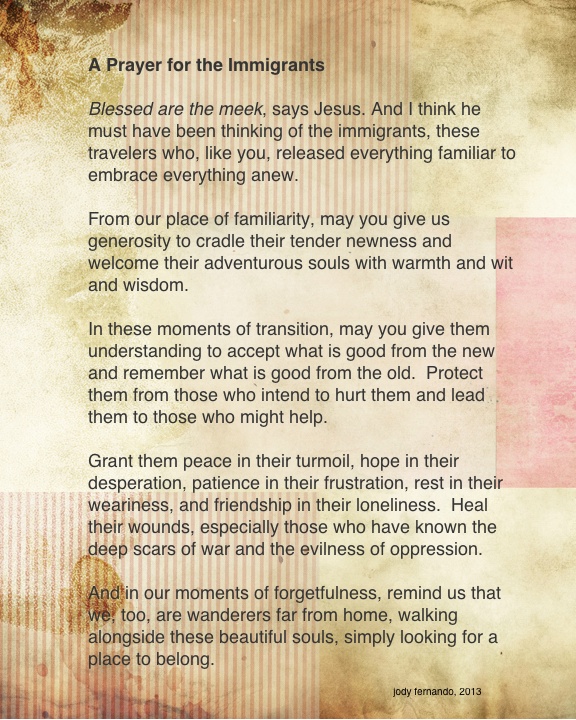
A prayer for the immigrants

I have a new job teaching English to adult immigrants, and, in just about a week, these dear people have captured my soul.  They are tenacious, courageous, funny and kind.  Here is my prayer for them.

immigrant prayer

Belief, Spiritual Formation

Finding my way home

One of the things I value about change is the fresh perspective it offers. While there’s great value in knowing one place for a long time, it does tend to get pretty comfortable. There’s not as much impetus to ask why? because you already know, to explore because you’ve been their before, to stretch yourself because there are so many comfortable places.

Obviously, I don’t have near the knowledge of this new place as I did of my old home, so I find myself asking a lot of questions:

Where’s a good beach for kids?  Which grocery store is cheapest?  Where can I buy Sri Lankan food? Why are so many people knocking on my door to convert me?  How do I stay alive on the freeways?  

On top of the daily ins-and-outs, there’s also a lot of asking going on in my heart:

Where’s home? How do I live between worlds here, at the crossroads of the worlds?  Will I ever belong anywhere?  Who can I trust?  What’s the right way to go? How honest can I be without offending?  What habits do I need to unlearn?  and the never-ending question… How do I respond to the pain I see around me?

Jeremiah 6:16 reminds me that my way of asking is all wrong:

This is what the Lord says:
Stand at the crossroads and look;
ask for the ancient paths,
ask where the good way is, and walk in it,
and you will find rest for your souls.”
 

While I want answers, the Lord says to seek direction.  While I look for clear-cut rights and wrongs in conflict, the Lord tells me to seek goodness.  While I hope for a quick-fix, a one-step solution, the Lord wants me to walk faithfully.  One. step. at. a. time.

I know that the details of the daily will eventually fall into place (just as long as I figure out the freeway thing).  The questions of my heart, however, need time to walk the ancient paths, to find the good way.  Today, I’m grateful that this change of home provides a undeniable opportunity to remind me to ask the questions that lead me there.

Belief, Miscellany

Change of plans

(Mark 14:37-38)

At the moment,
‘watch-and-pray’
feels more like
‘peek-around-the-corner-and-hope-I-make-it-out-alive.’
.
It must have been far easier for
James, Peter, John
to fall into a numb sleep
in the dark of that Garden
than to stare down
the paradox of
crushing loss creating
unimaginable gain.
.
The unknown
in beholding the Cross
whispers
what-if’s, what-for’s
how-to’s, dare-i-even-dream’s
as the spirits willing
war with the flesh failing.
Belief, Families, Children & Marriage, Spiritual Formation

For my children on their baptism

 
Bless the Lord who forgives all our sins;
His mercy endures forever.
 
“You are sealed by the Holy Spirit in Baptism and marked as Christ’s own forever,” Father Jim announced as he made the sign of the cross on your forehead.  This sacred moment – a pause in time when Christ marks you as his own – is part of your journey.  It is certainly not the end, but merely the beginning, that I long for you to travel your whole life long.
 

Though I cannot promise you it will be a simple path, I can attest mightily to its richness and depth.  For in every failure, there is forgiveness, in every brokenness – healing, and in every sorrow – restoration. It will surely not appear in the ways you expect, nor as easily as you hope, but as you walk in Christ’s way, it will come, steadfast and sure.

And we prayed for you[i], this:

 Heavenly Father,
we thank you that by water and the Holy Spirit
you have bestowed upon these your servants the forgiveness of sin,
and have raised them to the new life of grace.
 
Sustain them, 
O Lord, in your Holy Spirit.
Give them an inquiring and discerning heart,
the courage to will and to persevere,
a spirit to know and to love you,
and the gift of joy and wonder in all your works.
.

So many symbols and words that you do not yet understand.  But the simplicity of Christ’s love you see clearly – that he loves you with a greater fierceness than even your mama, and he gently waits for you to come to him for this love.  You are his forever child, cherished and beloved, and it is this love to which you respond.

How this mama loves your little souls –  full of so much wonder, joy, life.  How I both anticipate and fear watching this prayer fulfilled in your lives.  As each generation discovers anew, there will be great need for you to inquire, to discern, to be courageous, to persevere.  Much of this I hope you might learn from me, however, some of it I concede you will not.  As you know well enough already, a perfect mama I am not. Continue reading “For my children on their baptism”

Belief, Spiritual Formation

Grace, wine, and smelly men

Kneeling between the old-lady-in-a-matching-sweater set and the man-whose-scent-packs-quite-the-punch, the sweet message of the wine-soaked wafer melted in my mouth.

The body of Christ,

The bread of heaven,

The rector said as he handed me a wafer. What were we all doing there, I wondered, this motley bunch of us?  What brings us to kneel like that, to posture our bodies in humility and quietness?

I fashion myself somewhat ‘put together’.  I have a career, clean my house, take regular showers, love my family.  I catch myself reasoning that these qualities qualify me for a place at the altar over my currently-kneeling-neighbors. My ‘togetherness’ allows me to feel deserving of my place.

In contrast, I examine the old lady, and while her sweater sets are remarkably coordinated, she’s, well, old.  And I’m fairly certain that the smelly man has a few more issues than just lack of shower.  I found myself wondering how such a variety of individuals ended up elbow-to-elbow in prayer, and why anyone but me deserves to be there [reader, kindly note that I’d much prefer to leave this thought sitting subconsciously in my head…].

The body of Christ. 

The bread of heaven.

When I return to my seat, Grace, a sweet woman who has trouble with mental stability, passes my pew.  I catch her eye. Continue reading “Grace, wine, and smelly men”