Miscellany

Back up!

After a brief hiatus to spend some time in quiet reflection, I’ve decided to reopen things here.  I can’t predict how much I’ll post, only that the waters are beginning to clear and the writer in me is longing to push it’s way out again.

I continue to marvel at the contacts I make online, and look forward to continuing to connect with others through sharing here.

Miscellany

Ordinary Holy

i’ve been nostalgic for my babies lately.  no, i don’t want another, just remember the sleepless years with a bit of fondness since i finally have some distance.  

this is for all the young mothers, buried under a pile of onesies, tantrums, and spitup, wondering what the hell happened to their voice  and hoping they’ll someday find it again.

somewhere deep down

i am

a poet

but right now,

i’m doing the laundry.

.

how did this happen,

this daily, mundane takeover?

dishes, diapers, dust –

these are not the things

of which a poet speaks.

but they are the things

of my today.

.

how do I meld these two words –

Ordinary.

Holy.

without either Continue reading “Ordinary Holy”

Culture & Race, Families, Children & Marriage, Spiritual Formation

The quiet joy of healing

“What the caterpillar calls the end of the world, the creator calls a butterfly.”

-Judy Squier

When wounds begin to heal instead of just hurt, it’s sweet, tender process.  There are moments – like when the sun shines, the palms blow, and the mountains stand – that I breathe it all in with a deep thank you – one that I could not have even begin to muster even a year ago.

When I left the Midwest, I gave up a lot of me – a thriving career, proximity to my family, cultural mobility. Yet I also saw clearly that the loss of my own personal benefits meant an entirely new reality for my family: an environment that would value my husband for his skill more than his skin, that would offer my children the opportunity to grow up in a more diverse environment, that would challenge me to see beyond the familiar.  While I knew it was the right thing to do on so many levels, it still wasn’t the easiest pill to swallow with regards to my own personal gain. And yet, the path became so clear that I just kept walking (or perhaps more precisely, limping) all the way to California.

There are times since we arrived that I’ve felt like a popped balloon – blown into pieces from eight years of living in a place in which my most developed spiritual disciplines became speaking courageously, persevering, and hoping.  To say the least, it was not an easy place to live even though it was my home. Most of those years were spent begging God to either deliver us or change our hearts about living there.

swirl

When my daughter was one, she had a severe staph infection which resulted in a two week hospital stay and surgery in children’s hospital.  There were moments before her diagnosis when we didn’t know if she would live, or if she would have to fight a disease like cancer or rheumatoid arthritis.  Thankfully, the whole thing was resolved with no long term ramifications, but the day we finally left the hospital, we felt numb and weary, as though we’d been through a war.  Even in the midst of her illness, it hadn’t been hard to see the blessings in the whole situation. We had access to medical care. We had competent doctors. We had insurance. We had kind nurses whose shoulders I cried on. We had family to help. We had friends who prayed and brought food.  Our daughter had been healed. We acknowledged all of those things, and were so deeply grateful for them.

But even though there was so much goodness, we were still exhausted.  The hard parts had been just as real to us as the good ones.

Some experiences are difficult to share because the battered parts of our lives can sound so depressing.  We look better when we share our triumphs rather than our defeats.  Lest I sound like there was no goodness to our Midwestern years, let me share a bit. We loved our jobs and pouring into the lives of our students. There is nothing like watching young adults become flourishing, thoughtful people who care deeply about the world, themselves and other people. The strong spirits of the friends who loved and supported us through those years will long linger with me.  My children know and dearly love their grandparents, aunts, uncles, and cousins.  They have roots in my home and know what it is to trek across an empty cornfield and make angels in freshly fallen snow.

But, like having had a seriously ill child, the hard parts were just as real as the good ones. And, as I heal, sometimes those hard parts feel so very real that it’s difficult to imagine that I’ll ever fully understand God’s purpose to land us there for such a long time.

What I do grasp is the unexpected joy that sneaks up on me as I make a home here, in this place where God pulled us to.  It comes when I stand in front of my students and quietly observe how we understand each others’ experiences of relocating, recovering, healing, and making a new home.  Sometimes a tear sneaks into my eye as I watch them fight to learn English – a crazy-hard language – at age 60, and then brokenly explain to me how they pray to God to stop the war in their home.  It comes when we go to a park and relax because there are no confederate flags threatening our existence as an interracial family.  It comes when my children hear me speak Spanish and beg me to teach it to them, and when my daughter tells me how her best friend shared homemade sushi with her at lunch. It comes when my brother calls with plans to visit, and clearly shares my love for adventure as he plots his family’s trip West. It comes when we’re flying down the eight-lane freeway into a sunlit valley and I feel a freedom that I could not have ever created for myself*.

“It’s ok to be lonely as long as you’re free,” wrote the late Rich Mullins.  I learned this first in the Midwest, and I’m learning it again here in the California foothills.  We’re still new.  We’re still learning and establishing (which brings plenty of awkward and lonely moments), but the wounds of the past are slowly healing, and God is providing for us in ways I would have never dared to dream. While I know not what tomorrow brings, I’m so very grateful for this quiet joy that today holds.

swirl

When I began this blog seven (!) years ago, it was my effort to connect with others in similar situations at a time when I felt very culturally isolated in my life.  Given my new life change, life doesn’t feel nearly so isolating anymore, so I’m currently having an internal debate about the whole point putting of my words here.  Consequently, I might not be around much here until I figure this out, but I did want to at least write an ‘end’ to the story that began here, both to give credit where it is due and to provide some closure on this part of my life.  

*These moments occur nearly exclusively when my husband is driving.  I am still slightly petrified behind the wheel on the freeways here and find it difficult to feel anything but fear when it’s my responsibility to keep us alive on the road…


Related Posts


Belief

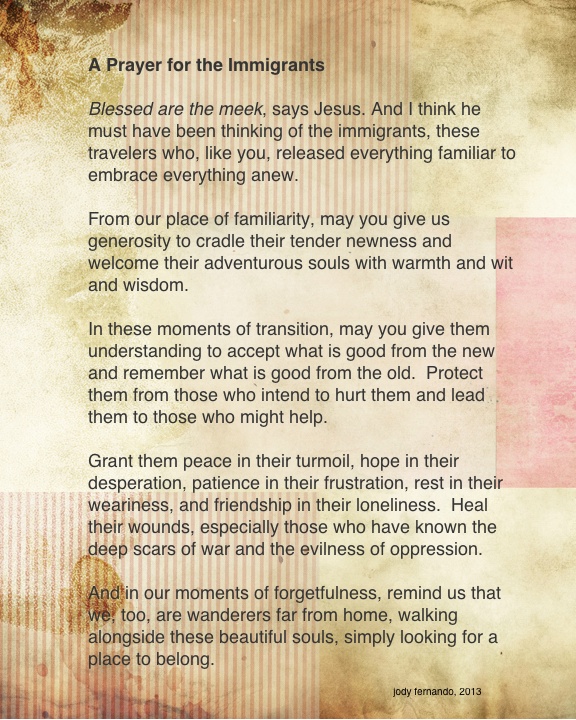
A prayer for the immigrants

I have a new job teaching English to adult immigrants, and, in just about a week, these dear people have captured my soul.  They are tenacious, courageous, funny and kind.  Here is my prayer for them.

immigrant prayer

Families, Children & Marriage

On raising bicultural children

A student made a short video about our family last Spring for a show put on by the multiethnic students, and I wanted to post it here so I wouldn’t lose the link to it.  Thought you might enjoy a glimpse of how we try to raise our kids to know both cultures…

Families, Children & Marriage

Dealing with isolation in intercultural marriage

I somehow missed this topic in my introductory post on A Long(er) View of Interracial Marriage, perhaps because it inherently carries less hope than the other topics I’ve covered.  I’ve been sitting on it for awhile because it’s more weary-and-burdened than come-to-Jesus, but it’s still a part of the story that needs to be told – harsh, but true.  

It’s been just over four months now since we’ve been the only interracial couple in town and I think I’m just beginning to thaw.  I had a dream last night that we were in Indiana and ran across two other interracial couples at a local restaurant.  When they saw us, they first looked shocked, then pleased.  I exchanged an awkward I-don’t-know-you-but-I-understand-why-you-look-so-excited-to-see-me glance with one woman as I walked out the door of a restaurant where we’d typically received what-are-you-doing-here stares.  Then, I went outside to sit on a blanket with my husband where we were going to have a quiet little picnic together.  My first inclination was to tell him, “There was another interracial couple inside!” which really translated to: “We’re not alone!  We really are ok!” but I couldn’t say a word.  Instead, I looked for food and realized we didn’t have enough, so I let my husband eat it and I went hungry, resting on the blanket in the warm sun, feeling quiet and sad.

When I woke up, I was confused why I’d felt sad.  Shouldn’t I have been happy that I’d seen another interracial couple?  It was then I realized what my emotions were settling into: we’re not the only ones anymore.  I haven’t felt that feeling of racial objectification in well over four months, and it feels soooo healing to be seen for ourselves and not our skin.  I realized that in my dream, I hadn’t really even wanted to tell my husband about who I’d seen. I was tired of talking about race and our inability to ever blend in.  We’d lived eight years scrounging for nourishment to sustain the interracial/intercultural part of our identity, and it simply wasn’t there.

My dream highlighted one of the hardest parts of interracial marriage we’ve encountered: isolation.  Not all marriages like ours face this, but when they do, it’s certainly not a cakewalk.  I don’t claim to suggest that we’ve always handled the isolation well – it many ways I still feel like a failure for not being able to withstand it.  In my head, I hear people whispering things like, “Why do they always have to make such a big deal about those things?” or “Can’t they just get over it?” or, perhaps the hardest of all, “If Jesus is what unites us, why does race matter?”  Ultimately, a significant piece of me feels guilty that escape was our only resolve.

Over the years, I’ve suspected many share our feelings of isolation for a variety of reasons – differing faith convictions, disabled children, addiction, divorce, dysfunctional childhoods – really anything that causes them to stand out from the perceived norm. I find myself drawn to people willing to be honest about the path they’re walking without over-spiritualizing their response to it.  At the same time, I acknowledge that any peace won in the midst of such struggles ultimately comes from a place of deep spiritual grounding.

“Come to me, all you who are weary and burdened, and I will give you rest,” Jesus promised. Clearly he knew we’d all feel lonely at some point. The reality that I’ve observed is that while we’re quick to advertise our “come-to-Jesus” responses to our struggles, it’s not nearly as safe to share the “weary-and-burdened” ones.  I wish I could offer more direction on this, but it’s a very unresolved struggle for me.

So, I’m curious…  How do you live in your unresolved and isolating struggles?  What characteristics do you see in people who do this ‘well’?

Other articles in this series:

A longer view of intercultural marriage

Practicing grace in intercultural marriage

Practicing patience in intercultural marriage

Social & Political Issues, Women

Naked lies

I’ve been busy settling into life here on the West coast, processing and growing from and understanding all the new around me.  Hence, I haven’t had much to post here since I prefer to process things, then share them.  Clearly, I’m still processing!  Here’s one small thought I’ve been chewing on:

The half-naked image advertising liposuction on the billboard, unfortunately, did not escape my seven year old son’s gaze.

“Sheesh!” he exclaimed dramatically. Rather than commenting on the nakedness (as seven year old – well, actually, any boys – are prone to do), his next comment surprised me, “Why do women think they have to be so skinny all the time?!? They look fine the way they are.”

Damn you, Los Angeles.

Don’t you dare go ruining my little boy’s fine views of women.

I really like your beaches and mountains and weather and all, but this whole obsession with flat tummies is a bit much.  Apparently, Hollywood knows it’s a problem, it’s just not willing to change its image.  When Hunger Games lead Jennifer Lawrence says, “In Hollywood, I’m obese” and concludes that she’ll “be the only actress who doesn’t have anorexia rumors”, I think we can safely assume there are some misaligned priorities being paraded in mainstream culture. It’s not just about being a size two, looking sexy in a bikini, and having an enviable body. It’s about the souls of women, about us exchanging, as my cousin so powerfully explains, our lives for our bodies.

Ironically, the story wasn’t too different in the Midwest.  It was just told from the other extreme – obesity – people attempting to fill their souls by obsessing over food. Instead of not eating enough, they ate too much.  In DC, it was all about power. Worldwide, lust for both human bodies and material goods consumes a huge amount of our energy. Clearly, our problem is not about food, it’s about longing for more, whether it’s food or perfection or iphones, and living on the surface rather than digging deep. Instead of promoting the depth that wholeness brings, society parades the shallowness of its brokenness on billboards.

Living at the surface is tempting on so many levels…For one, it’s a whole lot easier to dress up our outsides than to clean up our insides. A close friend battling with anorexia recently sent me an email about her process of doing just this, “How do I sink this love that [God] has for me straight into the empty parts of my heart?” she asked. “All my life I’ve gone from god to god to try to fill that deep deep emptiness to no avail.  And I don’t know what the rest of this journey looks like but this I know… His truth will set me free.”

Wholeness begins with the willingness to boldly proclaim, “The emperor has no clothes!” because it’s true, instead of keeping our mouths shut because no one else is saying anything. Or, putting it in today’s terms, “Damn you, Los Angeles and your impossibly flat stomachs.  You don’t fool me with your lies,” and then letting that truth sink straight to the empty parts of our hearts.

Miscellany

First breath of home

Image

I caught my first breath of home this weekend.

Driving down route 66, our aging mini-van echoed with laughter as my son entertained us with his car-seat-dancing-antics.  The giggles rolling, we rounded a curve toward the mountains, and my soul breathed a sigh of belonging. Three-months in, this new place felt like home for the first time.  The road, the mountains, the palm trees, even (dare I say) all those pesky inappropriate billboards we have to keep explaining to our kids (for the record, “AdultCon” is just a meeting for adults, and the couple humping each other on the back of the motorcycle were just cuddling, ok?) felt familiar and part of life.

Out the window, a (gratefully appropriate) billboard summed up the moment:  Vive hoy.

Live today.

I smiled.

That’s what our giggling, ice-cream filled souls were doing.

We were living.

In our home.

Mountains watching our every move. Pollution coating my outdoor laundry room. Decadent signs of wealth. Desperate murmurs of the unemployed. Spanish, everywhere! More cultures than I can count. Horchata stands at the grocery store. Stoplight buttons. Freeway mazes. Trader Joe’s ten minutes from my house. Indian grocery stores that sell carom boards and cricket bats. Traffic jams and road closures.  Fender benders that make me go argh. Seas of new faces. An endless supply of Asian food.

So many moments are forming snapshots of our new life in this place. And today, it feels oh-so-good.

Vive hoy.

We ended the day listening to a university choir sing a concert of praise in an atrium framed by the California sunset.  The power of their voices proclaimed the depth of a simple truth I have long known.

All to Jesus, I surrender

All to him I freely give.

I will ever love and trust him,

in his presence daily live.

And their melody reminded me that for all the loss and hard moments that come with transition, the surrender of my life to the One I love and trust can be as breath-taking as these quiet mountains that are slowly starting to feel like home.

Books

Book Review: Cinderella Ate My Daughter

It’s been awhile since I’ve reviewed anything (probably shows how much I’ve read lately!), but this book was so compelling I wanted to document my thoughts on it…

My husband and I have had on-going conversations over the course of our parenting about the impact of American cultural realities like the Disney princesses, Hannah Montana, and the ever-present marketing monster of materialism.  At first, I didn’t fully follow his thinking on why these entities might not be the best role models for our impressionable daughter.  He felt that they painted a weak picture of women, encouraged women to form their identity around a man, and sucked innocent children into the never-ceasing macine of American consumption.  Because I’d grown up with Disney, I hadn’t put much thought into its underlying message before, but his opinions made sense, and I could support his point.  Over the years, though, I’d occasionally wonder if he was really right.  I mean, don’t all little girls like princesses?  What’s so wrong with wanting to dress cute and act like a rock star?  Are beauty pageants really that bad or are they just harmless fun for little girls?   Is pink really the only color my little girl can wear?

In her book Cinderella Ate My Daughter, Peggy Orenstein addresses my questions in detail, giving specific examples about how beloved mainstream media female characters like Hannah, Cinderella, and yes, even my beloved Dora send very mixed messages to our daughters.  She cites studies, analyzes cultural trends, and digs into marketing tactics regarding the messages being sent to our girls through popular mainstream characters and cultural trends like pink and sparkly girl-oriented toys, pop-star role models turned pole dancers, and failed Disney princesses.

And while I never really disagreed with him, I now have the details to back up what my husband’s intuitive sense was.  Throughout the book, Peggy repeatedly examines a few ideas:

  • What messages do our daughters receive about who they should be from what they see on TV?
  • What do positive role models look like for girls?
  • How aware are parents of the impact culture has on what our children believe about themselves and the world?

While I don’t fully agree with all of her conclusions, I wholeheartedly concur with her basic premise that we shouldn’t thoughtlessly allow our daughters to form their female identity on characters whose deepest aspiration is to catch a man or wear a cute outfit.  I also deeply appreciate her conclusion that, in the end, our highest priority is to teach our daughters to “see themselves from the inside out rather than the outside in”.

Families, Children & Marriage, Restoration & Reconciliation, Social & Political Issues

9/11, Jesus, and patriotism: My kids’ take on it all

When I picked my kids up from school yesterday, they were a bit amiss about the 9/11 ceremony at their school.  Apparently, everyone had cheered when the leader referenced killing ‘bad guys’ in Afghanistan.  I listened quietly to their conversation with each other, processing what had happened.

“I didn’t clap,” my daughter protested.  “I mean, it’s not like Americans are good all the time. We do bad things too.”

“Yeah,” my son added. “And children there affected by all this and they didn’t even do anything to deserve it. How would we feel if we were them?”

“I don’t understand why everyone cheered about killing someone else,” the chatter continued as they attempted to understand the perspectives they’d seen.

“I just kept thinking about Priyan Baapa,” my daughter commented, referring to her great uncle whose office had been in the World Trade Center, but who had left the building early that fateful day to pick up Starbucks on the way to a meeting.

They mutually agreed that the whole state of the world is unfortunate, that America isn’t above or below any of them, and that while we fix some problems in the world, we also create an equal number of them.

Out of a seeming nowhere, they determined a solution.  “It’s the church,” my daughter mused. “They’re the ones who can help fix all this.”

Now, if we talked about the church like this on a regular basis, I’d have seen this one having been coming.  But sadly, conversations in our house reflect deep disappointment with and brokenness over the church as much as they do over the hope its potential holds.  But even at 9, her little heart intuitively senses that, for as much as the governments try, they have it all messed up, and that more answers lie at the feet of Jesus than at the foot of the flag.

She gets it, that kid.  Perhaps more than her skeptic-of-a-mama.  One comment at a time, she’s building my faith that kingdom of God might actually be a part of the plan to bring peace on earth.

Families, Children & Marriage, Restoration & Reconciliation

Practicing grace in intercultural relationships

But what we can do, as flawed as we are, is still see God in other people, and do our best to help them find their own grace. – Barack Obama

Grace is a tricky subject…a whole lot more elusive than patience.  It’s a gift, something undeserved that gives us freedom to be as we are, while still pushing us beyond the wallowing of the current moment. Continuing the series from A Longer View of Intercultural Marriage, today I’ll reflect more deeply on ways to practice grace in intercultural relationships:  

With those who don’t understand

It still makes me shudder to remember the day years a sweet, kind woman I enjoyed chatting with at work referred to my children as ‘half-breeds’.  I swallowed hard in that moment, wondering if I’d heard her correctly.  As she continued talking, she clearly had no idea how offensive her terminology had been to me.  She was speaking so effusively of them – how beautiful she finds biracial children, how she’s always found mixed race children stunning.  Clearly, her words weren’t meant to offend.  Being a single mom who’d spent her whole life in rural Indiana, she’d had no opportunity to interact with an outside world to understand how offensive her words were to me (frankly, I think it would have horrified her to know how offended I was).  By filtering her words through grace, I was more able to accept them for what they were: affirming words from a kind person.

Perhaps closer to home are family or friends who give well-intentioned advice about how we should approach our choices about relationships or child-rearing across cultures.  When this happens in my life, I must remind myself that while my loved ones do mean well, they simply don’t understand.  (And for that matter, may not be able to.  There are many scenarios I don’t currently have the ability understand like raising a disabled child or being a single parent.)

With those who *think* they understand

For me, this skill is harder than any of the rest combined.  It’s one thing when people admit ignorance, and a wholly different impact when they assume expertise without having it.  I’m sure most people have at least one person like this somewhere in their  corner of the world, so I’ll just leave the specific examples to the imagination.  One helpful skill I learned from author Jan Johnson when dealing with difficult people like this is to pray that God would show me a person’s heart. This helps me to remember that they are fallible and broken just like me, and that perhaps they, too, make a mistake or two every once in a while. Continue reading “Practicing grace in intercultural relationships”

Families, Children & Marriage

Practicing patience in intercultural relationships

great-white-egret-58421_640

In reflecting more deeply on some of the themes I introduced in the post A Longer View of Intercultural Marriage, I’ve been pondering the role of patience in an intercultural marriage.  While undeniable that patience is a virtue in all marriages, I want to spend some time unpacking what it looks like in an intercultural marriage.

In the familiarity of marriage, cultural differences quickly lose their fascinating qualities and grow exasperating.  Conflicts over gender roles, authority figures, or child-rearing require a lot of time and honesty to sort through.  To expect clear-cut understanding immediately when culture plays a role in your relationship usually results in frustration and conflict.  Some couples will fight it out.  Others might simply crumble under the pressure.

Enter: patience – the ability to step back, take a breath, and assess the situation before responding.  What actually is may not be what it seems.  Take some time to make sure you understand before jumping to conclusions.  I’ll be the first to admit I don’t always practice it, but when I do, things often go much differently than when I go with my knee jerk reaction.

Deep breaths are helpful, but they don’t really resolve anything if all they do is give you more oomph to scream at your partner.  Here are a few ways I’ve practiced patience over the years:

  • Read.  If I’m stuck, it always helps me to sort through fact and feeling.  Reading about culture, marriage, relationships, or any combo of the above helps me understand and process our own relationship in a more productive way.  It also lets me sit quietly and calm down if I’m angry. Here are some of my favorite books on intercultural marriage. I also like the Culture Shock series as a starting point for understanding culture from an American perspective.
  • Call a friend.  I don’t call friends to bitch and moan, but to process, to sort through what is my responsibility and how I can take care of my side of the street.  My friends in intercultural relationships can be more helpful at times because they have experienced being in a relationship similar to mine.
  • Write.  Being a writer, I gain a lot of clarity sorting things out on paper.  But anyone can benefit from this practice.  Writing forces me to think through what I want to say rather than just throwing it out there.  It also gives me some space to collect my thoughts in an understandable way, and to determine what’s helpful to say out loud and what isn’t.
  • Set a time to talk when emotion is less intense.  I know the old adage says to never go to sleep on your anger, but we’ve found that sometimes our best choice is to just go to sleep.  A rested mind can give me a whole new perspective on things.  It also helps me to bring up issues I don’t understand at a neutral time, rather than right in the midst of conflict.  While I lean toward conflict avoidance, this approach hasn’t been a useful tool to help us build a strong relationship.  Differences must be sorted out and understood or one of us starts to feel like we’re getting trampled on.
  • Identify the emotional load.  The deeper the cultural notion, the higher the emotional stress load.  The Iceberg Concept of Culture is a really helpful tool to identify where I’m feeling the stress and often provides a helpful starting point with my husband.
  • Ask for help.  One of the best decisions I’ve ever made was to seek counseling when we hit problems we couldn’t resolve ourselves.  Counseling isn’t just for people with “big problems”, and friends can lack the depth of understanding they need to help in certain situations.  An objective viewpoint helps to sort through where the issues are and how to find middle ground in them.


Now…your turn!  When has your intercultural relationship required intense patience?  What actions help you practice patience?  

Spiritual Formation

Come visit me at Far, Far Away

I’m guest posting today about painting my fingernails over at Far Far Away.  Head on over to check out why it’s more about bravery than vanity… here’s a sneak peek:

I don’t want to pass this unresolved habit of years of bleeding cuticles and peeled-off fingernails along to her. I don’t want my brokenness to show up on her hands too.

Belief, Spiritual Formation

Finding my way home

One of the things I value about change is the fresh perspective it offers. While there’s great value in knowing one place for a long time, it does tend to get pretty comfortable. There’s not as much impetus to ask why? because you already know, to explore because you’ve been their before, to stretch yourself because there are so many comfortable places.

Obviously, I don’t have near the knowledge of this new place as I did of my old home, so I find myself asking a lot of questions:

Where’s a good beach for kids?  Which grocery store is cheapest?  Where can I buy Sri Lankan food? Why are so many people knocking on my door to convert me?  How do I stay alive on the freeways?  

On top of the daily ins-and-outs, there’s also a lot of asking going on in my heart:

Where’s home? How do I live between worlds here, at the crossroads of the worlds?  Will I ever belong anywhere?  Who can I trust?  What’s the right way to go? How honest can I be without offending?  What habits do I need to unlearn?  and the never-ending question… How do I respond to the pain I see around me?

Jeremiah 6:16 reminds me that my way of asking is all wrong:

This is what the Lord says:
Stand at the crossroads and look;
ask for the ancient paths,
ask where the good way is, and walk in it,
and you will find rest for your souls.”
 

While I want answers, the Lord says to seek direction.  While I look for clear-cut rights and wrongs in conflict, the Lord tells me to seek goodness.  While I hope for a quick-fix, a one-step solution, the Lord wants me to walk faithfully.  One. step. at. a. time.

I know that the details of the daily will eventually fall into place (just as long as I figure out the freeway thing).  The questions of my heart, however, need time to walk the ancient paths, to find the good way.  Today, I’m grateful that this change of home provides a undeniable opportunity to remind me to ask the questions that lead me there.